
Greyhound Open Races vs Graded: How Race Types Differ at Yarmouth
 Available in US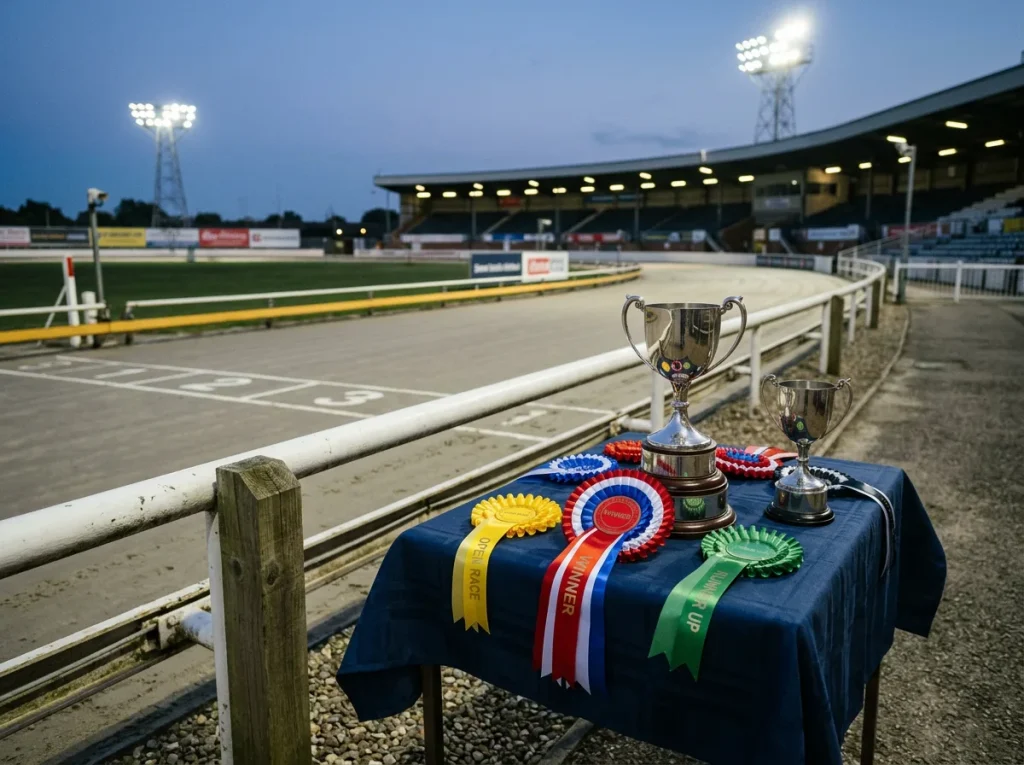
I backed a dog in a Yarmouth open race once using exactly the same analysis I applied to regular graded meetings, and I got taken apart. The dog’s form was solid, its grade was right, its trap draw was favourable – and it finished fifth behind four dogs I had never seen on the Yarmouth card before. That was the evening I learned that open races and graded races are fundamentally different competitions, even when they take place on the same track over the same distance, and that your approach to one cannot simply be transplanted to the other.
The distinction between open and graded racing sits at the heart of how greyhound competition is structured in Britain, and understanding it is essential for anyone who bets on Yarmouth across different meeting types.
See also: yarmouth dogs results and understand race grading explained.
How Graded Races Are Structured
Graded races make up the overwhelming majority of racing at Yarmouth. Every regular BAGS meeting – Monday, Wednesday and Sunday – consists entirely of graded events, where the fields are composed of dogs from the resident Yarmouth population, matched by the racing manager into grade bands designed to produce competitive races.
The system works by grouping dogs of similar ability together. An A5 race contains dogs whose recent times and form at Yarmouth place them in the A5 band – not fast enough for A4, not slow enough for A6. The result is that most graded races produce close finishes, because the dogs are deliberately matched to be competitive with each other. This is the design intent: tight fields that generate betting interest and entertaining racing.
GBGB has scheduled 50 Category One and 27 Category Two competitions for the centenary year, but these sit above the regular graded calendar and represent a different tier of racing. The standard graded meetings that fill most of the fixture list are the bread and butter – predictable in structure, rich in data and amenable to systematic form analysis. Total prize money across UK greyhound racing exceeds £15 million annually, but the bulk of that is concentrated in the higher-tier events, leaving graded meetings to operate on more modest purses.
Open Races: Entry, Prize Money and Competition Level
Open races break the graded structure entirely. Instead of matching dogs by ability within a single track’s population, open races invite entries from any track, any trainer and any grade – subject to minimum qualification standards. The result is fields that can include dogs from five or six different venues, each carrying form from different tracks with different geometries, different surfaces and different grading systems.
The prize money for open races is typically higher than for graded events, which is what attracts the better dogs. The East Anglian Derby at Yarmouth is the prime example – a Category One competition with a £15,000 winner’s prize that draws entries from across the country. But there are also smaller open events throughout the year, category races with more modest but still elevated purses, and invitational competitions that sit between the graded and fully open tiers.
The competition level in open races is unpredictable in a way that graded racing is not. A graded A4 field at Yarmouth will contain dogs you have seen race at the venue multiple times, with form lines you can trace back over weeks or months. An open race field might contain dogs whose entire racing history has been at other tracks, with form you cannot directly compare to the Yarmouth standard without adjusting for venue differences. The information asymmetry is much greater, which is why open races are harder to analyse and why the betting market is less efficient.
How Your Betting Approach Should Change by Race Type
The practical implications are significant and specific. For graded racing at Yarmouth, I rely heavily on data: trap statistics, time analysis, grade trends, trainer patterns and sectional splits. The data is deep because the same dogs race at the same venue repeatedly, producing large samples that statistical methods can exploit. My graded-race selections are systematic and data-driven, and they produce consistent results over time precisely because the racing environment is stable and measurable.
For open races, the data-driven approach breaks down. The visiting dogs have no Yarmouth form, which means my trap statistics, time adjustments and grade analysis are partially or wholly inapplicable. Instead, I shift toward a different set of tools: the pace map becomes more important because I am trying to predict what happens at the first bend with dogs whose running styles I may not know from direct observation. The trainer’s reputation and track record in open competition becomes a stronger signal than individual form figures. And the trial times – if the visiting dogs have run a Yarmouth trial before the competition – become the single most valuable data point, because they are the only time the dog’s speed has been measured on the track it is about to race on.
I also adjust my staking. Graded races at Yarmouth are where I invest the majority of my betting bank, because the edge is more consistent and the outcomes more predictable. Open races get a smaller allocation, because the higher variance means that even a well-reasoned selection carries more risk. The increase in prize money and the allure of the bigger occasion tempt many punters into overbetting on open events, which is a mistake I made early and have since corrected.
There is also a timing dimension. The market for open races at Yarmouth tends to be less liquid and more volatile in the early pricing stages, because bookmakers are setting prices on fields they have less data for and bettors are making assessments with incomplete information. Prices can move dramatically between the morning tissue and the off, more so than in graded races where the form is well known. If you are betting on an open race, watching the price movements in the final fifteen minutes can tell you where the informed money is going – and whether your own assessment aligns with or diverges from the market’s revised view.
The separation between graded and open racing is one of the structural features of the sport that every Yarmouth punter needs to understand, and it feeds directly into the analytical framework I apply to all racing at this track, including the data-led tips approach that accounts for race type in every selection.
See also: Yarmouth Grading System with relevant background information.
