
Yarmouth Trap Stats: Bias Patterns, Win Rates and Draw Analysis
 Available in US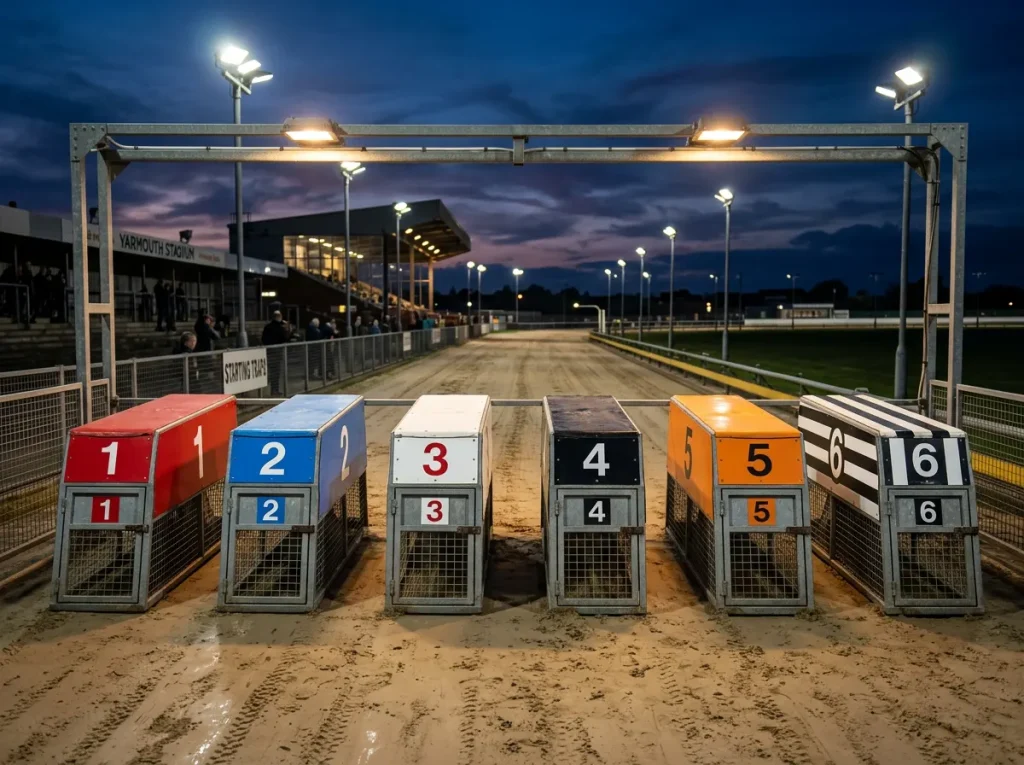
Three years ago I started logging every Yarmouth result I could get my hands on, not because I enjoy spreadsheets — I absolutely don’t — but because a conversation in a betting shop convinced me I was leaving money on the table. A regular punter told me he’d backed trap one in every 277-metre sprint at Yarmouth for six months and come out ahead. I thought he was joking. He showed me the receipts.
That exchange sent me down a rabbit hole that eventually became the core of my approach to this track. The national picture is clear enough: trap one wins roughly 18 to 19 per cent of all UK graded races, which is comfortably above the 16.6 per cent you’d expect if all six traps were equal. But national averages flatten out the differences between tracks, and Yarmouth is not a generic oval. Its 382-metre circumference, 85-metre run-up and Outside Swaffham hare produce trap bias patterns that are specific, measurable and — if you know where to look — exploitable.
This article breaks those patterns apart by distance. I’ll explain why the geometry creates the bias, show you how the overall numbers look, then zoom into each of Yarmouth’s four race distances to show where the real edge sits. If you already understand the basics of trap bias and just want the distance-specific data, skip ahead to the breakdown section. If the whole concept is new, start here — the physics of it takes about two minutes to grasp, and once you’ve got it, you’ll never look at a trap draw the same way again.
See also: yarmouth dogs results and check the latest trap statistics.
How Yarmouth’s Track Layout Creates Trap Bias
Every greyhound track creates trap bias for the same fundamental reason: the first bend is not a straight line. Six dogs leave the boxes in a horizontal row, but within seconds they need to funnel into a single-file or double-file line to navigate a curve. Dogs on the inside have less ground to cover around the bend. Dogs on the outside have more ground but also more room to manoeuvre. The specific balance between those two forces depends on three things: the length of the run-up before the first bend, the tightness of the bend itself, and the position of the hare rail.
At Yarmouth, the run-up measures 85 metres. That’s not the longest in British racing — some tracks give you over 100 metres — but it’s long enough that the field has time to accelerate to near-maximum speed before the bend arrives. A longer run-up generally dilutes inside-trap advantage because dogs in wider traps have more straight-line distance to establish position. A shorter run-up compresses the field and amplifies the inside edge because the bend arrives before the outer dogs can get clear.
The circumference of 382 metres produces bends that are moderately tight by UK standards. Tighter bends increase the distance penalty for wide runners; more sweeping bends reduce it. Yarmouth sits somewhere in the middle, which means the inside advantage exists but isn’t as brutal as at a tight track like Romford. The surface is sand, which grips differently from the Astroturf or peat used at some other venues, and grip variations after rain or wind can shift the racing line slightly — but the geometry is the primary driver of bias, not the surface.
Then there’s the hare. Yarmouth uses an Outside Swaffham model running on the outside rail. This matters because dogs are instinctively attracted to the hare, and an outside hare pulls the field toward the outer line through the bends. The effect is subtle but persistent: it doesn’t eliminate the inside-trap advantage, but it reduces it slightly compared to tracks where the hare runs on the inside rail, because dogs in wider traps are running closer to the lure’s line and therefore take a marginally more natural path through the turns.
Put all three factors together — moderate run-up, moderate bend radius, outside hare — and you get a track where inside traps hold an advantage overall, but that advantage is less extreme than at many venues and shifts meaningfully across distances. That’s the architectural reality. The numbers confirm it.
Overall Trap Win Rates at Yarmouth
Before I drill into individual distances, here’s the aggregate picture. Across all distances and all grades at Yarmouth, the trap win rates follow the general UK pattern: trap one leads, trap six trails, and the middle traps cluster together. The national benchmark for trap one sits at roughly 18 to 19 per cent, and Yarmouth’s overall figure tracks close to that range. Traps two through five each win somewhere between 14 and 17 per cent, depending on the sample period. Trap six consistently underperforms relative to fair share.
These aggregate numbers are useful as a sanity check — they tell you the bias exists and confirm the direction — but they’re not precise enough to build selections around. The reason is that aggregating all four distances into one number blends genuinely different patterns. The 277-metre sprint and the 843-metre marathon produce almost opposite bias profiles in some boxes, and averaging them out hides both signals.
There’s a broader context worth noting. Across all 18 licensed UK stadiums, which collectively stage more than 70,000 individual races per year, trap one outperforms at nearly every venue. The variation is in how much. At some tracks the inside box wins over 22 per cent of the time; at others it barely clears 17 per cent. Yarmouth falls into the moderate camp, which makes it a track where trap draw is important but not deterministic. You can’t just back trap one and expect to profit long-term — but you can’t ignore the draw either. The distance-level data is where the actual decisions get made.
Trap Bias Broken Down by Distance
This is where the data gets genuinely useful. I’ve broken the trap bias at Yarmouth into its four racing distances — 277, 462, 659 and 843 metres — because each distance uses the track differently. The number of bends varies, the relative importance of early pace changes, and the hare’s pull has more or less time to influence the field. Yarmouth runs all four distances on its 382-metre circumference, but the start positions are staggered around the track, which means the geometry of the first bend is not identical for every trip.
277m Sprint: Inside Dominance
Over 277 metres there is one bend, and the race is functionally decided in the first five seconds. A dog that breaks fast from trap one or two and reaches the bend in front has an almost insurmountable advantage because there’s simply no time or distance left for a rival to overtake. I’ve watched hundreds of Yarmouth sprints and the pattern is relentless: the inside traps dominate.
Trap one’s win rate over the sprint distance is consistently the highest of any trap-distance combination at Yarmouth. Trap two also outperforms its fair share, though by a smaller margin. Traps three and four cluster near the expected 16.6 per cent, and traps five and six underperform significantly. The practical takeaway is blunt: if you’re betting on Yarmouth sprints, the trap draw is the first filter. A slow beginner drawn in trap six over 277 metres is a losing proposition regardless of what its form line says.
The exception — and there’s always an exception — is the wide-drawn fast breaker. A dog with a sub-5.00 first-sectional time drawn in trap five or six can sometimes rail up on the outside through the single bend and hold position to the line. But this is the exception, not the rule, and it requires the inside dogs to be slower out of the boxes. Backing against the bias over 277 metres is a low-percentage play.
462m Standard: The Balanced Middle
The 462-metre trip is Yarmouth’s bread and butter — the distance most graded races are run over, the distance the East Anglian Derby uses, and the distance where form comparisons across dogs are most meaningful. It involves four bends, which gives the race enough duration for early-pace errors to be corrected and for dogs with tactical speed rather than raw gate speed to find a route through.
Over this distance the trap bias flattens considerably compared to the sprint. Trap one still holds a slight edge, but it’s measured in single percentage points above fair share rather than the five-plus-point bulge you see at 277 metres. Traps two and three perform close to expectation. The interesting shift is that trap four and sometimes trap five start to show competitive win rates — not because the outside draw is inherently good, but because over four bends there are enough opportunities for a dog with a strong mid-race pace to make up the initial positional disadvantage.
For my own selections over 462 metres, I treat the trap draw as one factor among several rather than the dominant one. A dog with proven early pace from trap one is still an attractive proposition, but a dog with a strong closing sectional from trap four can win this race too. The key question over this distance is not “which trap?” but “which running style suits the likely pace scenario?” — and that brings the racecard’s sectional columns into the conversation.
659m Stayers: Bend Advantage
At 659 metres, the race involves six bends and the balance tips further away from raw draw advantage toward stamina and racing intelligence. Dogs that settle early and conserve energy through the middle bends tend to have more to give in the final straight. The trap bias over this distance reflects that: inside traps still perform slightly above average, but the margin is thin enough that I’d never back or oppose a dog purely on its box number.
What I have noticed at this distance is a bend-position effect. Dogs drawn in traps three and four — the middle boxes — sometimes show the best win rates over 659 metres because they avoid the rail crowding that can hamper trap one and the extra ground that penalises trap six, while still having enough room to navigate the multiple bends without losing position. It’s a narrow effect and not always statistically significant across shorter sample periods, but it’s consistent enough that I factor it into my thinking.
The 659-metre trip is where trainer data becomes more important than trap data. Certain kennels at Yarmouth prepare genuine stayers; others enter dogs that are really 462-metre types trying to stay an extra trip. The form figures will usually tell you which is which — a dog that finishes strongly at 462 metres but hasn’t been tried beyond that distance is a question mark over 659, regardless of trap draw.
843m Marathon: Pace and Positioning
Marathon races at 843 metres are the least common on the Yarmouth card and consequently the hardest to build large data samples for. The race covers eight bends — effectively two full laps of the track plus a partial section — and by the time the field reaches the second half of the race, the starting trap draw has been diluted almost completely by the accumulated effects of pace, crowding, bend positioning and stamina.
My data on marathon trap bias at Yarmouth is thinner than I’d like, but the trend is clear: trap draw matters less here than at any other distance. The win rates across all six traps cluster much more tightly around the 16.6 per cent fair share than they do at 277 or 462 metres. If anything, the middle traps show a marginal edge because they avoid the most crowded racing lines at the first bend without conceding too much ground on the outside.
Over this trip, I essentially ignore the trap column as a selection factor and focus instead on the dog’s proven stamina, its mid-race sectional profile, and the trainer’s record with marathon runners. If you back a trap-one specialist over 843 metres just because it’s drawn inside, you’re applying sprint logic to a stamina test — and that’s a mistake I’ve made more than once before learning to let the data guide me.
Outside Swaffham Hare and Its Impact on Draw
I touched on the hare earlier, but it deserves its own section because the Outside Swaffham model at Yarmouth produces an effect that’s easy to misunderstand. The hare runs on the outside rail, ahead of the dogs, and every greyhound in the race is chasing it. That instinctive pursuit creates a slight centrifugal pull: dogs naturally drift toward the outside of the track as they chase the lure, because the lure is on the outside.
At tracks where the hare runs on the inside rail, the pull works in the opposite direction — dogs are drawn toward the rail, which compresses the field and makes inside traps even more valuable. Yarmouth’s outside hare partially offsets the geometric inside-trap advantage by giving outer-drawn dogs a fractionally more natural running line through the bends. The dog in trap five or six is already closer to the hare’s path, so it doesn’t need to adjust its line as aggressively as the dog in trap one, which has to balance its inside position against the outward pull of the lure.
Sir Philip Davies, GBGB’s chairman, has spoken about the need for sustainable funding across the sport’s infrastructure — “funding for the sport has to be sustainable,” as he put it at the 2026 awards — and part of that infrastructure is the mechanical lure system at each track. The Swaffham model is well-established and reliable, and its outside-rail positioning is a fixed feature of Yarmouth’s racing character. It won’t change, so the bias patterns it creates are structural, not seasonal.
Practically, this means that at Yarmouth you should be slightly less dismissive of wide draws than you would be at an inside-hare track. The outside Swaffham doesn’t eliminate the inside advantage — the geometry still favours low-numbered traps over short distances — but it softens it, and over the longer trips it’s one of the reasons why wide draws are more competitive here than the national averages might suggest.
Using Trap Stats in Your Selections
Knowing the bias exists is the easy part. Using it without falling into the trap of oversimplification is harder. Here’s the framework I use to integrate trap stats into my Yarmouth selections without letting them override everything else on the card.
Step one: identify the distance and recall the bias profile. Over 277 metres, trap draw is the primary factor. Over 462 metres, it’s one of several. Over 659 and 843 metres, it’s a tiebreaker at most. This takes two seconds and immediately tells me how much weight to give the draw in this particular race.
Step two: check whether the dog’s running style aligns with its draw. A fast breaker from trap one over a sprint is a strong combination. A slow breaker from trap one over a sprint is a weak one, because the dog will get squeezed into the rail on the first bend by faster starters from traps two and three. The trap stat tells you what the box can do in theory; the dog’s sectional profile tells you whether this specific dog can exploit it in practice.
Step three: compare the trap stat to the market. If trap one’s theoretical win rate over 277 metres is around 22 per cent but the bookmaker’s odds imply a 30 per cent chance, the market has already priced the bias in and there’s no value. If the odds imply only 15 per cent, the market is underweighting the draw and there might be an edge. This step requires a basic understanding of implied probability — divide one by the decimal odds to get the implied percentage — but it’s the step that turns trap data from interesting trivia into actionable information.
Eighteen licensed stadiums across Britain run more than 70,000 races a year. Each track has its own geometry, its own hare, its own bias profile. What works at Yarmouth won’t necessarily transfer to Swindon or Perry Barr. The discipline is to build and trust the data for the specific venue you’re betting on, and to update it regularly as track conditions and kennel rosters evolve. Trap stats are a tool, not a system — and like any tool, they work best when you understand both their power and their limits.
See also: Greyhound Trap Draw Colours to deepen your understanding.
