
Yarmouth Greyhound Racecard: How to Read and Use Every Column
 Available in US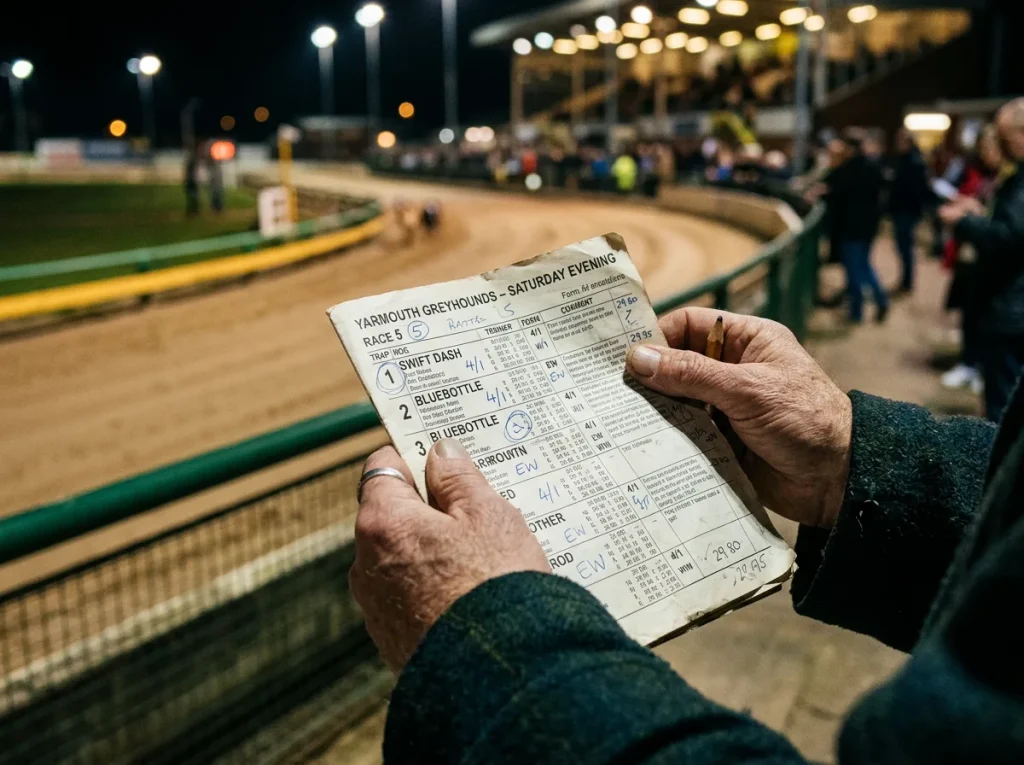
I remember the first time I sat down with a Yarmouth racecard and thought I knew what I was looking at. I’d been following the dogs for a couple of years at that point, mostly at Romford and Crayford, and assumed a card was a card. Within three races I’d backed a dog dropping in grade who I thought was well drawn in trap two — only to watch him get swallowed on the first bend because I’d misread the sectional column and ignored the weight shift. That evening cost me about forty quid and taught me something I’ve repeated to anyone who’ll listen ever since: a racecard is not a list of runners. It’s a compressed argument about what’s likely to happen in the next thirty seconds of racing.
Yarmouth runs four distances — 277, 462, 659 and 843 metres — on a 382-metre circumference with an 85-metre run-up to the first turn and an Outside Swaffham hare. Every column on that racecard interacts with those physical facts. The trap draw means something different over 277 metres than it does over 659. The form figures carry different weight depending on whether the dog last ran at a BAGS meeting or an open-race card. The grade tells you roughly where the dog sits in the ability pecking order, but the weight column might tell you whether it’s actually ready to perform at that level tonight.
This guide breaks every column apart, explains what it measures, and — more importantly — shows you how to connect the columns to each other so the racecard starts telling a story instead of just displaying data. If you’re already comfortable with the basics and want to skip straight to how trap draw interacts with pace, jump ahead to the worked example at the end. Otherwise, start from the top.
See also: yarmouth dogs results for today’s racecard and selections.
Anatomy of a Yarmouth Racecard
Pull up any Yarmouth racecard — whether it’s a PDF advance card from the official stadium site or a digital version on one of the data aggregators — and you’ll see broadly the same layout. A header strip gives you the race number, the distance, the grade or race type, and the scheduled off time. Below that sits a table, usually six rows deep (one per runner), and anywhere from eight to twelve columns wide depending on the source.
The columns aren’t standardised across every provider, which is part of why people get confused. Some sources put the trainer next to the dog’s name; others tuck it into a sidebar. Some show calculated sectional times; others show only the finishing time. But the core information is always present, and it always appears in this general order: trap number and jacket colour, dog’s name and parentage, trainer, weight, grade, recent form figures, best recent time, and — on the better cards — sectional or calculated split data.
Think of the racecard as three layers. The first layer is identity: who is this dog, who trains it, what box is it running from. The second layer is historical: what has this dog done recently, expressed through form figures, finishing times and grade movements. The third layer is predictive: what do the numbers suggest will happen tonight, given the trap draw, the distance, and the competition in the race. Most punters read only the first two layers. The edge lives in the third.
I’ll work through each column in the order you’ll encounter it on a typical Yarmouth card. Where a column means something specific to this track — and several do, because of that 85-metre run-up and the Outside Swaffham hare — I’ll flag it. The UK’s regulated sector employs roughly 500 licensed trainers and around 3,000 kennel staff, and the data they generate for every run feeds directly into what you see on the card. None of it is filler.
One last thing before we dive in. Racecards for BAGS meetings at Yarmouth — the Monday, Wednesday and Sunday morning sessions that form the bulk of the fixture list — tend to carry less supplementary data than the Saturday evening open cards. That’s not because the information doesn’t exist; it’s because BAGS cards are compiled on tighter turnaround times. If you’re serious about form study, you’ll often need to cross-reference the card with a results archive to fill in what the printed version leaves out.
Trap Draw and Jacket Colours
The leftmost column on every racecard is the trap number, and it comes with a colour code that’s universal across British greyhound racing: trap one is red, two is blue, three is white, four is black, five is orange, and six is the distinctive black-and-white stripes. These aren’t decorative. The jacket colours are physically worn by the dogs so that judges, camera operators and — critically — punters in the stands can track who’s who at forty miles an hour around a bend.
At Yarmouth, the trap number matters more than at many tracks because of the geometry. The 85-metre run-up from the boxes to the first turn is relatively generous by UK standards, which gives wider-drawn dogs a fraction more time to find position before the field compresses. But the Outside Swaffham hare runs on the outside rail, and that creates a persistent pull toward the outside line through the bends. Nationally, trap one shows a win rate of roughly 18 to 19 per cent against a theoretical fair share of 16.6 per cent — but at Yarmouth, the interaction between the hare rail and that long run-up produces patterns that shift meaningfully by distance.
Over the 277-metre sprint, inside traps dominate. There’s only one bend, so a dog drawn in trap one or two who breaks cleanly has almost no opportunity to be overtaken. Over the 462-metre standard trip, the bias flattens out because the extra bends allow wider runners to find racing room. Over 659 and 843 metres, stamina and bend craft start outweighing raw draw advantage. I’ve tracked these patterns across several hundred Yarmouth BAGS cards and the distance-specific variation is one of the most reliable edges available at this track.
When you look at the trap number on a Yarmouth card, ask two questions immediately. First: what distance is this race? Second: does this dog have early pace? A trap-one draw means nothing if the dog is a slow beginner who gets bumped at the first bend. A trap-six draw over 277 metres looks poor on paper, but a fast-breaking wide runner who can hold the rail through a single turn can still win. The trap column is the starting point of every race analysis, not the conclusion.
Decoding Form Figures and Recent Results
A string of numbers and letters next to a dog’s name — something like 3211 or 54m32 — is the form line, and it’s the single most misunderstood column on the racecard. I’ve lost count of how many times I’ve heard someone say “that dog’s in great form, look at all those ones and twos” without stopping to ask where those ones and twos were earned, against what grade of opposition, and over what distance.
The form figures read left to right, oldest to newest. A sequence of 3211 means the dog finished third, then second, then first, then first again in its last four runs. Letters interrupt the numbers: m means the dog was bumped or impeded at some point during the race, and the number after it shows where it finished despite the trouble. A capital W means wide running — the dog raced on the outside through the bends. D means it was involved in a dispute for the lead. These letters are not excuses; they’re data points. A dog showing 4m3m2 might look mediocre on raw finishing positions, but if it was impeded twice and still finished in the top three, it could be better than its numbers suggest.
At Yarmouth specifically, the form figures need to be read alongside the grade column. Favourites win roughly 35.67 per cent of graded races across all UK tracks, but that national average masks enormous variation. A dog showing 111 in A8 grade is simply beating weak opposition. The same dog promoted to A5 might suddenly show 445 because the jump in class is too steep. Conversely, a dog dropping from A3 to A5 with a recent form line of 5643 might be about to win at a canter because the grade change puts it in with slower dogs.
The trick I use is to ignore the raw positions on first reading and instead look at the trend. Is the dog’s finishing position improving, deteriorating, or stable? Then I overlay the grade. If positions are improving and the grade is staying the same or rising, you’re looking at genuine improvement. If positions are improving but the grade has dropped, you’re looking at an illusion — the dog isn’t better, the opposition is worse. This distinction is where most casual racecard readers go wrong.
One more thing about form at Yarmouth. Because it’s a BAGS track running three or four times a week, the turnover of races is fast. A dog might have six recent runs all at Yarmouth, all over 462 metres, all in A6. That density of same-track, same-distance form is gold for analysis. Contrast that with a dog whose form line includes runs at three different tracks over two different distances — that form is harder to read because you’re comparing different geometries, different surfaces, and different competitive contexts. When I see a Yarmouth regular with a clean form line at one distance, I pay attention.
Weight, Grade and Class Indicators
Somewhere on your racecard you’ll find two columns that most people glance at and forget: the dog’s racing weight in kilograms and its current grade. Together, these two numbers tell you more about a dog’s immediate readiness than its form line does.
Weight first. Every greyhound is weighed before each race, and the figure appears on the card alongside the weight at its previous outing. A typical racing greyhound weighs between 26 and 36 kilograms, but what matters isn’t the absolute number — it’s the change. A drop of half a kilogram between runs can indicate a dog that’s been trained hard and is sharp. A gain of a full kilogram might suggest a dog that’s been rested and could be carrying extra condition. Neither change is automatically good or bad, but both require context. A weight drop in a dog that was already racing lean could mean it’s overtrained. A weight gain after a spell off could mean it’s been freshened up deliberately.
The rough rule I work to: anything within 0.3 kilograms of the previous run is neutral. Between 0.3 and 0.7, I want an explanation — has the dog changed kennels, been ill, or had a break? Above 0.7 in either direction, I treat the run as a watching brief rather than a betting proposition. The registered sector in Britain tracks approximately 6,000 active greyhounds and around 15,000 registered owners, and the weight data is one of the few objective physical measurements that makes it onto the public racecard. Use it.
Grade is the other half of the equation. At Yarmouth, graded races run from A1 (the highest standard for the track) down to A10 or sometimes lower. The grade is assigned by the racing manager based primarily on the dog’s recent times at the track’s standard distance. When a dog wins, it gets promoted — usually by one grade. When it finishes unplaced repeatedly, it drops. The system is designed to keep races competitive by matching dogs of similar ability, but it creates predictable patterns that sharp racecard readers can exploit.
The most valuable grade scenario is the dog that’s just been promoted after a win. It’s going up a level, facing faster opposition, and the market often underestimates how much tougher one grade step actually is. Conversely, a dog dropping in grade after a couple of poor runs is frequently underloved by the market because its recent form looks bad — but the drop in class might be all it needs. I keep a simple log of dogs that are racing one grade above or below their previous run. Over the past few years, grade droppers at Yarmouth have shown a materially higher win rate than the market implies.
Sectional Times and Calculated Splits
If form figures are the racecard’s autobiography, sectional times are its medical scan — they show you what’s happening beneath the surface. A finishing time tells you how fast a dog completed the race. A sectional time tells you how fast it ran specific portions of that race, and the difference between the two is where serious form analysis begins.
Not every Yarmouth racecard includes sectionals. The official advance cards from the stadium often show only the overall finishing time. To get sectional data, you’ll typically need to look at results after the meeting, where some aggregators calculate splits based on in-running positions recorded at bend markers. These calculated sectionals are estimates, not stopwatch readings, so they carry a margin of error — usually within a few hundredths of a second. But even approximate splits are enormously useful.
Here’s why. Two dogs can run 462 metres in identical times of, say, 28.40 seconds and have completely different running styles. Dog A might clock 5.20 to the first bend and 23.20 for the remaining distance, indicating fast early pace that fades slightly through the home straight. Dog B might run 5.55 to the first bend and 22.85 for the rest, indicating a slow starter who finishes powerfully. In a race where both dogs are drawn next to each other, their sectional profiles predict a very specific scenario: Dog A will lead into the first bend, Dog B will be several lengths behind, and the question is whether Dog B’s closing speed can make up the deficit before the line.
At Yarmouth, the 85-metre run-up amplifies early-pace differences because there’s more ground to cover before the first bend compresses the field. A dog with a quick first sectional at Yarmouth might not have the same advantage at a track with a shorter run-up, and vice versa. This is precisely why I don’t trust finishing times transplanted from other tracks without adjusting for sectional profiles. A 28.40 at Yarmouth and a 28.40 at Romford are different performances because the track layouts distribute speed differently across the race.
When I study sectionals on a Yarmouth card, I’m looking for three things. First, dogs with improving first-bend times — that suggests the trainer has worked on the dog’s early pace, which is a positive signal. Second, dogs with strong closing splits despite poor finishing positions — that usually means they encountered trouble early and are better than the form line shows. Third, dogs whose sectionals have become erratic — fast one run, slow the next — because inconsistency in sectional profiles often precedes a drop in overall performance.
Trial Times on the Yarmouth Advance Card
Yarmouth’s official advance cards contain something that most tracks don’t make publicly available in the same format: trial times. These are clocked runs — either solo or in pairs — recorded at the track before the dog is graded or regraded. Trial data sits in its own column on the advance card, usually expressed as a raw time over the relevant distance with an annotation indicating whether it was a solo trial (S) or a trial with another dog (T).
Trainers trial their dogs for different reasons. A new arrival from Ireland will trial to establish its initial grade. A dog returning from injury trials to prove fitness. A dog that’s been regraded might trial to confirm the new time band. Each of these contexts changes what the trial time means, and that’s the part most people miss. A solo trial time of 28.20 over 462 metres looks quick, but a dog running alone, with no competition and no crowding, will almost always clock a faster time than it will under race conditions. The standard adjustment I use is to add somewhere between 0.15 and 0.30 seconds to a solo trial to estimate race-day performance, depending on the dog’s running style.
Trial times for dogs appearing on the Yarmouth advance card are particularly useful when a dog is making its debut at the track. If a greyhound has been racing at Crayford or Swindon and shows up on a Yarmouth trial card, its trial time is the only Yarmouth-specific data you’ve got. Cross-reference it with the dog’s form at its previous track, adjust for the difference in circumference and run-up length, and you’ve got a reasonable starting estimate of how it’ll perform.
One habit I’ve developed: when the advance card drops, I scan the trial column for any dog trialling faster than its current grade would suggest. If a dog is graded A6 but has just trialled at a time that would put it in A4, something has changed — new trainer, recovered from injury, different distance. That discrepancy is a signal, and it’s sitting right there on the card for anyone who bothers to look.
Trainer and Kennel Information
The trainer column looks like the least important piece of data on the card. It’s just a name, after all. But in a sport where the dog can’t tell you how it’s feeling and the form figures only show what happened last time out, the trainer’s identity is a proxy for a cluster of hidden variables: kennel routine, feeding regime, trial intensity, preferred running style, and — crucially — how aggressively the trainer grades its dogs.
Yarmouth has a core group of kennels that supply the bulk of runners for its BAGS cards. Some of these trainers have strong records at specific distances. Others have a reputation for bringing dogs to peak condition quickly after a break. A few are known for their ability to prepare Irish imports for their first UK run. None of this information appears on the racecard in text form, but the trainer’s name is the key that unlocks it if you’ve done your homework.
What I track is simple: win rate and strike rate by trainer, broken down by grade band and distance. Over a sample of a few hundred races, clear patterns emerge. One kennel might win 22 per cent of its 462-metre entries in A5 and below but only 9 per cent in A3 and above, telling you its dogs are competitive at mid-grade but struggle in the higher classes. Another might show consistent results across all grades but only over the sprint distance. These patterns are stable over time because they reflect the trainer’s methods, not random variation.
Tiffany Blackett, GBGB’s executive veterinarian, has noted the progress around long-term welfare strategy within the regulated sector, and that welfare infrastructure — kennel inspections, injury reporting, retirement obligations — indirectly shapes how trainers manage their dogs. Kennels that invest in recovery and conditioning tend to produce more consistent performers. The trainer column won’t tell you that directly, but tracking which kennels show low injury rates and steady form lines over months will.
Putting It All Together: A Worked Racecard Example
Theory without application is just trivia, so let me walk you through how I’d read a hypothetical Yarmouth racecard from start to finish. This isn’t a real card — I’m constructing it to illustrate the process — but every detail is grounded in patterns I’ve seen repeatedly at this track.
The race is a 462-metre A5 graded affair on a Monday BAGS card. Six runners, as always. I start with the trap draw and the distance. Over 462 metres at Yarmouth, the trap bias is relatively flat compared to the sprint, so I’m not handing any trap an automatic advantage. But I am noting which dogs have early pace, because the 85-metre run-up means the first bend arrives quickly enough that a slow breaker from trap one can still get squeezed.
Runner in trap three shows form of 2114 in A5, weight steady at 31.2 kilograms (same as last run), and a recent 462-metre time of 28.35. That form line says: consistent at this grade, holding weight, and clocking a competitive time. No alarm bells. But I flip to the sectional column and see the first-bend split has slowed by 0.10 seconds over the last two runs. That’s a yellow flag — this dog might be losing a step of early pace, which at Yarmouth over 462 metres means it’s arriving at the first bend half a length further back than it used to.
Runner in trap six shows form of 5m421 in A6, weight down 0.4 kilograms from last run, and a recent time of 28.55 — slower on paper than trap three. But this dog was in A6 last time and has just been promoted to A5 after winning. The m in its form line three runs back indicates trouble — bumped mid-race — so the fifth-place finish that day was misleading. Dropping 0.4 kilograms suggests it’s been sharpened up. And the 28.55 in A6 might translate to 28.35 or faster in a race where stronger competition pulls it along. This is the dog I’d be interested in, despite the wide draw, because its trajectory is upward and the market will likely focus on trap three’s cleaner form line.
The trainer column confirms my instinct: trap six’s trainer has a 19 per cent strike rate at 462 metres in A5 to A6 and has won twice from trap six at this distance in the past couple of months. Trap three’s trainer is reliable but shows a declining sectional trend across the kennel’s recent runners, suggesting a possible kennel-wide condition dip.
I’m not saying trap six is a certainty. Nothing in greyhound racing is. But the racecard, read as a connected story rather than a set of isolated columns, points me toward a runner the market is likely to undervalue and away from one the market is likely to overvalue. That process — connecting columns, reading trends, overlaying context — is what separates a punter who reads the card from one who just looks at it. Nearly two-thirds of graded races are won by something other than the favourite, and the racecard is where you find those somethings.
See also: Yarmouth Results Today for more details on this topic.
