
Yarmouth Greyhound Grading System: How Dogs Move Between A1 and A10
 Available in US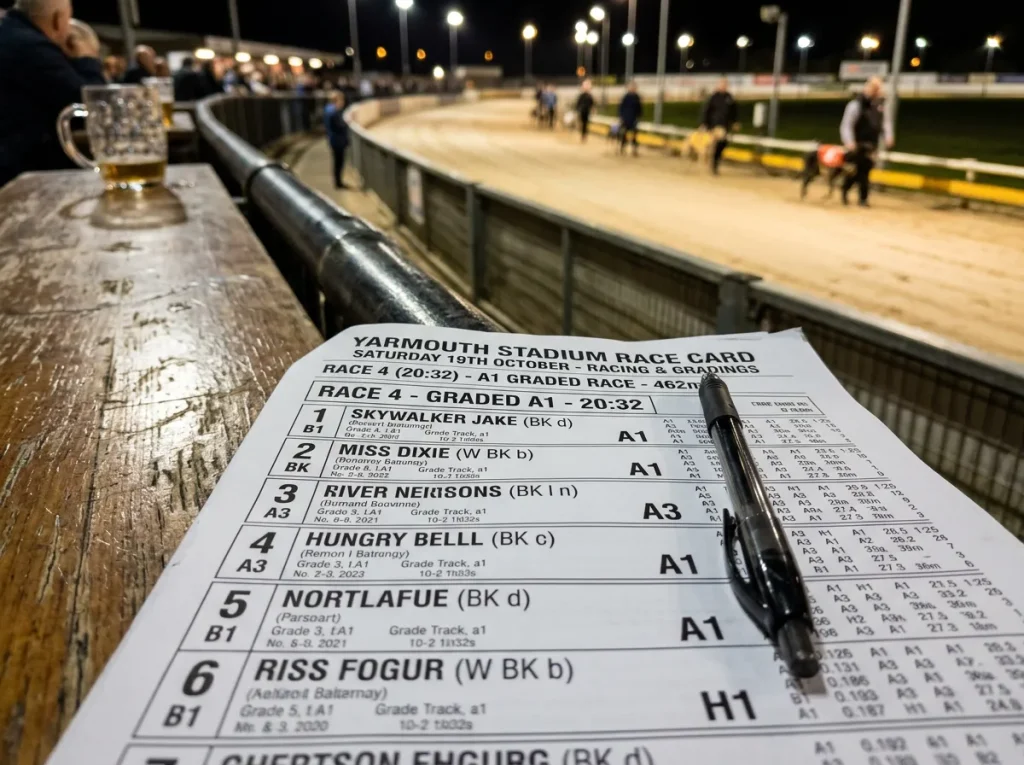
Every greyhound that steps onto the Yarmouth track wears a grade like a badge – A1, A4, A7, whatever it happens to be – and most punters glance at it without understanding what it actually represents. I spent my first two years following the dogs treating grades as a rough indicator of quality, nothing more. It was only when I started tracking individual dogs through their grade changes that I realised the grading system is not just a label – it is a mechanism that creates predictable patterns in the results, and those patterns are where some of the best value in greyhound betting lives.
The UK operates 18 licensed stadiums, and between them they produce over 70,000 individual races a year. Every one of those races is graded, and the grading system is the engine that keeps the competition balanced and the fields competitive. Understanding how it works at Yarmouth specifically – not just in theory, but in practice – is fundamental to reading the form.
See also: yarmouth dogs results for full grading and race information.
How Grading Works: Time-Based Grade Assignment
Forget what you think you know about grades being a simple ranking of ability. The grading system in UK greyhound racing is primarily time-based, which means a dog’s grade is determined by the times it runs over a given distance at a specific track. This is an important distinction – a dog graded A3 at Yarmouth is not necessarily the same standard as a dog graded A3 at another venue, because each track has its own time bands and its own grading structure.
At Yarmouth, the racing manager assigns grades based on the dog’s recent times over the track’s standard distances. When a dog first arrives at the venue – whether from another UK track or imported from Ireland – it runs a trial to establish a baseline time. That trial time determines the initial grade. From there, the dog’s grade is reviewed based on its race performances, with the most recent times carrying the most weight.
The grade bands are structured as a ladder: A1 at the top for the fastest dogs, descending through A2, A3 and so on. Most Yarmouth cards run races from A3 or A4 down to A8 or A9, though the exact range depends on the pool of dogs available at the venue on any given week. The key point is that grades are relative to the venue’s population, not an absolute national standard. A dog can be regraded simply because the competition around it has changed, even if its own times have stayed the same.
Favourites win approximately 35.67% of graded races across the national circuit, but the figure varies significantly by venue – from around 31.60% at the tightest tracks to over 42% at venues where the grading produces less competitive fields. Where Yarmouth sits in that range depends on how tightly the racing manager grades the fields and how deep the pool of available dogs is at each grade band.
Promotion, Demotion and the Reassessment Cycle
A dog that wins a race does not automatically go up a grade, and a dog that finishes last does not automatically go down. The reassessment process is more nuanced than that, and it is this nuance that creates the betting opportunities.
When a dog wins, the racing manager reviews its winning time. If the time is fast enough to suggest the dog is now running at a level above its current grade, the dog gets promoted – moved up one or sometimes two grades. If the dog won in a slow time – perhaps because it led from the front and the rest of the field was poor – it might stay in the same grade. Promotion is not automatic; it is a judgement call based on the time.
Demotion works similarly but in reverse. A dog that runs a string of poor times – finishing mid-pack or worse over several races – will be dropped to a lower grade where it faces slower competition. This is designed to keep the dog competitive and the races close, which is in the interests of both welfare and the betting market.
The reassessment cycle creates a pattern that experienced punters recognise. A dog that has just been promoted is entering a higher grade where it will face faster opposition. Its recent form figures might show consecutive wins or places, but those were earned at the lower grade. The question is whether the dog’s ability carries over to the new level. Conversely, a dog that has just been demoted is dropping into a grade where it should, on paper, be competitive again – and its recent poor form might have been a product of being outgraded rather than any loss of ability.
Why Grade Changes Create Betting Opportunities
This is where my ears prick up every time I study the Yarmouth card. Grade changes are the single most undervalued piece of information on the racecard, and they create two specific types of opportunity.
The first is the recently demoted dog. The market sees a dog with recent form figures of 5-4-6 and prices it accordingly – mid-range in the betting, maybe 5/1 or 6/1. But those figures were earned in a higher grade against faster dogs. Now the dog has been dropped to a level where its actual speed is competitive, and those poor-looking form figures do not reflect its ability in the new grade. I have backed hundreds of recently demoted dogs at Yarmouth over the years, and the strike rate is markedly better than the starting prices suggest.
The second opportunity is the recently promoted dog that the market overvalues. A dog with form figures of 1-1-2 looks impressive, and the market reacts – it goes off favourite in its first race at the higher grade. But those wins came against slower opposition, and the step up in class means the dog is now facing dogs with similar or faster raw speed. The drop in competitiveness is often dramatic, yet the market, driven by recent results rather than grade context, fails to adjust the price enough.
The practical application is straightforward. Before every Yarmouth meeting, I check the racecard for any dog running in a different grade from its most recent race. If the grade has changed, I ask whether the form figures still mean what the market thinks they mean. More often than not, they do not. That gap between perceived form and actual grade-adjusted ability is the edge, and it ties directly into the broader form analysis process for Yarmouth.
See also: Open Races vs Graded for practical tips and examples.
