
Yarmouth 843m Marathon: The Longest Distance and How to Analyse It
 Available in US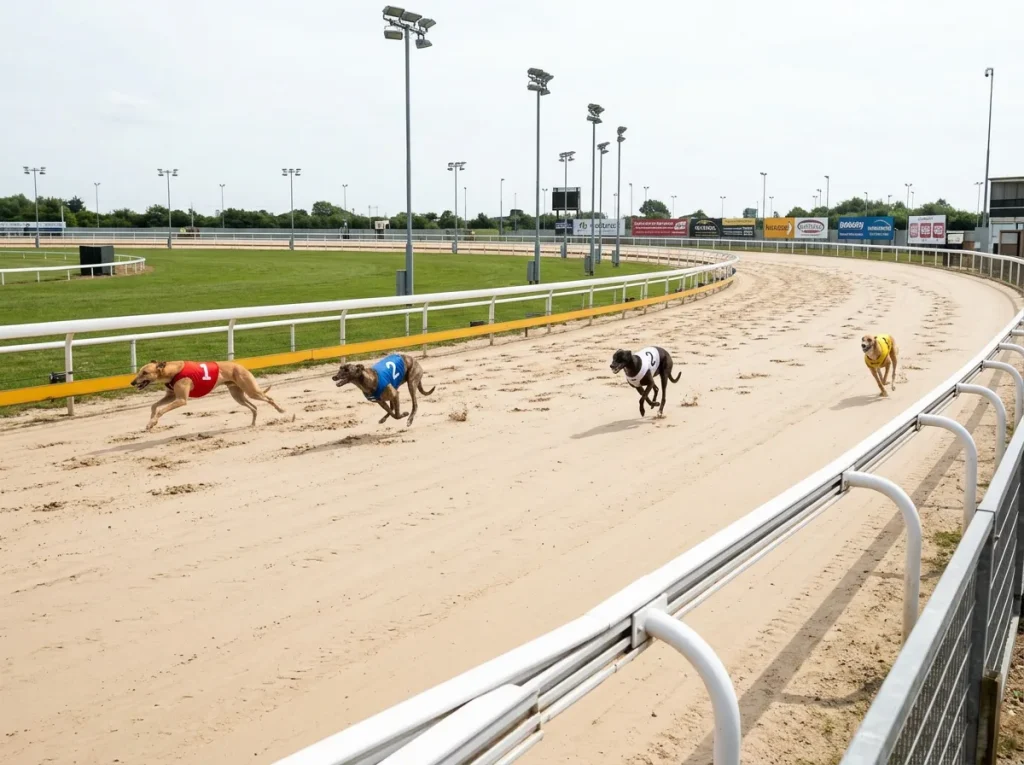
The first time I watched an 843-metre race at Yarmouth, I remember thinking the dogs had missed the finish line. They swept past the winning post, carried on around the bend and kept going. Marathon racing is the rarest distance on the card and the most misunderstood – it attracts smaller fields, less betting volume and far less media attention than the standard trips, which is precisely why it rewards careful study more generously than any other distance.
At Yarmouth, the 843m marathon covers just over two full laps of the 382-metre circuit. That means eight bends, two complete straights and a finishing stretch that arrives when most dogs are well into the red zone of their physical effort. The distances available at Yarmouth – 277, 462, 659 and 843 metres – form a clear ladder, and the marathon sits at the top, demanding everything a greyhound has in terms of stamina, temperament and racing intelligence.
See also: yarmouth dogs results and check marathon distance records.
How the 843m Marathon Plays Out at Yarmouth
Marathon races have a rhythm that is entirely different from anything over a shorter trip. The opening phase – that same 85-metre run to the first bend – matters less here than at any other distance. A slow break from the traps at 277m is catastrophic. At 843m, it is barely relevant. The race is so long that positional changes through the first two bends are provisional at best. What matters is where a dog sits at the end of the first full lap and how much effort it has spent getting there.
The middle phase – from roughly the fourth bend to the sixth – is where marathon races are shaped. This is the section where dogs that have been dragged along at an unsustainable pace start to come back to the field, and where patient runners start to move through the pack. Watching this phase is the closest greyhound racing gets to tactical horse racing, because positioning and energy conservation genuinely matter. A dog that sits fifth through the first circuit but moves smoothly into third by the sixth bend is travelling far better than a dog that has led from the traps and is now visibly shortening its stride.
The closing phase – bends seven and eight plus the final straight – is pure attrition. The dogs that are still running freely at this point are the genuine marathon types. Everyone else is hanging on. Winning margins in marathon races tend to be larger than over shorter distances, because the combination of tiredness and eight bends amplifies the gap between dogs that stay and dogs that empty.
Reading Marathon Form: What Standard-Distance Stats Miss
This is the section that could save you the most money, so pay attention. The single biggest error in marathon betting is applying standard-distance logic to a marathon field. Favourites across the country win around 35.67% of graded races, but that headline figure is dragged upward by the predictability of sprint and standard-distance events. Over marathon trips, the favourite wins less frequently because the extended distance introduces variables that the market – which is less liquid for marathon races – struggles to weigh properly.
Form figures earned over 462m or even 659m are unreliable guides to marathon ability. I have seen dogs with impeccable form over 462m – strings of wins, fast times, professional front-running – step up to 843m and finish last, completely spent by the sixth bend. The speed that served them over four bends becomes a liability over eight, because they burn through their reserves too quickly and have nothing left for the closing stages.
What I look for instead is a specific combination of signals. First, the dog’s finishing effort in its recent races – not the finishing position, but the manner of the finish. Was it still pulling to the line or was it emptying? Second, the dog’s weight. Marathon runners tend to carry slightly less bulk than sprinters, and a dog whose weight has been slowly trimmed over recent weeks may be being prepared for a step up in distance. Third, and most importantly, the trainer’s intent. Marathon races are specialist events, and trainers do not enter dogs at 843m casually. If a kennel with a history of marathon winners enters a relatively unexposed dog at this trip, that entry is a statement of intent backed by trial work you cannot see on the public form record.
The 18 licensed stadiums across Britain produce over 70,000 individual races a year, but only a small fraction of those are marathon events. The data set is thin compared to 462m, which means statistical analysis has to be supplemented with observational judgement. This is one distance where watching the replay – not just reading the result – is essential, and it ties directly into the broader approach to understanding Yarmouth’s results and form patterns.
Pace Judgement and Mid-Race Positioning
I want to share a concept that took me years to articulate, even though I had been using it instinctively: the marathon pace question. Before every 843m race, I ask myself one thing – which dog in this field is most likely to lead through the first circuit, and can it sustain that pace?
If the answer is yes – a known front-runner with genuine staying form – then the race will likely unfold from the front and the market favourite has a strong chance. If the answer is no – a quick breaker that has never raced beyond 462m – then the early leader is setting itself up for collapse, and the closers in the field become the play.
The beauty of marathon racing is that pace judgement is not a mysterious art. You can assess it from the form. A dog’s closing sectionals in its previous races, particularly over 659m, tell you almost exactly how it will handle the marathon distance. Dogs that consistently run their last two hundred metres faster than their first two hundred metres are natural marathon candidates. Dogs whose sectionals fall away sharply are speedsters entered over a trip they cannot sustain.
Mid-race positioning is the other half of the equation. In a field of six, the dog sitting third or fourth at the halfway point of an 843m race is often in the ideal position – close enough to strike when the leaders tire, far enough back to have conserved energy through the first lap. I pay more attention to mid-race positions in marathon results than in any other distance, because that mid-race snapshot is the truest predictor of which dogs will handle this trip again in the future.
See also: Yarmouth 277m Sprint with relevant background information.
