
Yarmouth 462m Results: The Standard Distance Explained With Key Data
 Available in US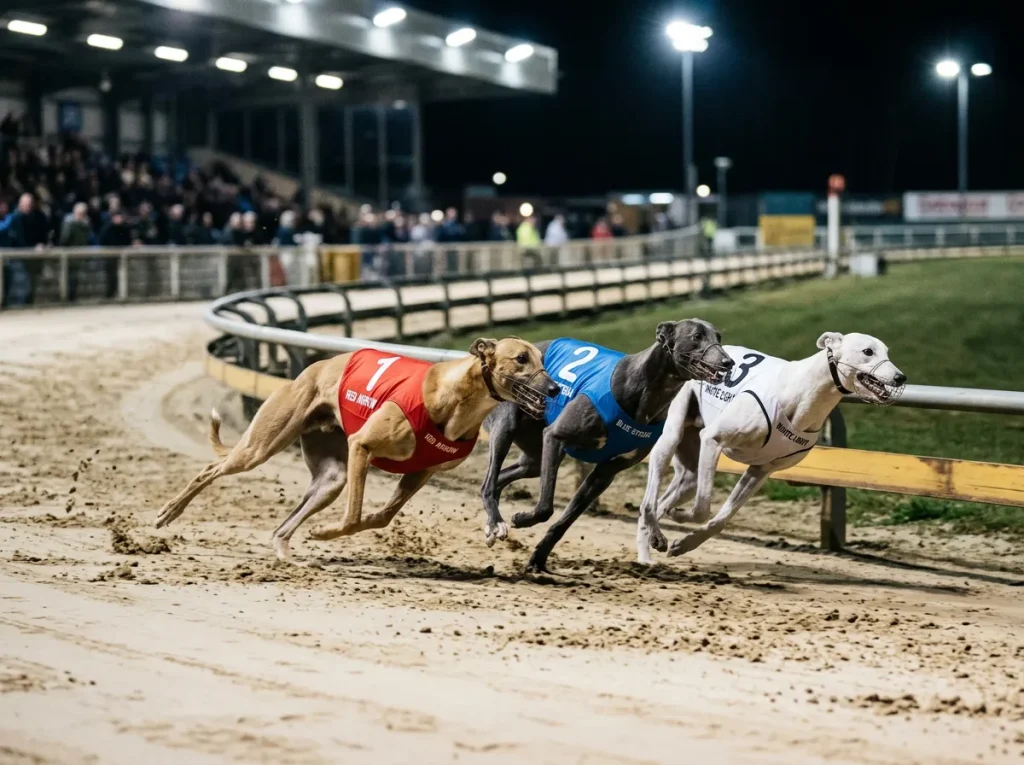
If you picked a single distance to define Yarmouth, it would be the 462 metres. This is the bread and butter of the track – the distance that fills most of the card on any given meeting, hosts the East Anglian Derby and produces the deepest pool of form data for analysis. I have spent more hours studying 462m results from Yarmouth than any other distance at any other venue, and the patterns that emerge when you know what to look for are remarkably consistent.
Yarmouth’s 462m trip is run over a full circuit of the 382-metre track, with an 85-metre run from the traps to the first bend. That run-up distance is a defining feature of the venue – it is long enough to give slower breakers a genuine chance to find their stride before the first bend arrives, which has a direct and measurable effect on how races unfold.
See also: yarmouth dogs results with results across all distances.
How the 462m Race Unfolds at Yarmouth
Every 462m race at Yarmouth follows the same physical path, but the way it plays out tactically depends on the makeup of the field. The dogs leave the traps, accelerate over 85 metres of straight, hit the first bend, then complete a full lap. The Outside Swaffham hare runs on the outside rail, which means dogs drawn in the wider traps do not have to cross in front of inside runners to chase the lure – they are already on its line.
That 85-metre run to the first turn is where most 462m races at Yarmouth are decided, even if the result is not confirmed until the home straight. A dog that reaches the first bend in front, on the rail, with clear air ahead will win more often than its raw speed alone would suggest. The converse is also true: a genuinely fast dog drawn in trap three or four that gets squeezed at the first bend and loses two lengths will struggle to make that ground up over the remaining distance, because the 462m only gives you one circuit to recover.
What makes the 462m interesting from a form perspective is that the distance is long enough for running style to matter but short enough that early pace is still king. At 277m, speed is everything. At 659m, stamina and tactical positioning take over. The 462m sits in the middle, which is why it produces the most competitive and unpredictable fields on the card. Dogs of quite different profiles – front-runners, mid-pack trackers, wide-running closers – all have a plausible route to winning if the draw and break go their way.
Typical Winning Times and What They Tell You
Winning times at Yarmouth over 462m typically fall between 28.50 and 29.60 seconds across the full range of grade bands, from A1 down to A10. That is a wide window, and the grade matters enormously. An A3 runner clocking 28.70 is performing within expectations. An A7 runner clocking 28.70 has either been massively undergraded or the going was abnormally fast that day.
The East Anglian Derby – Yarmouth’s flagship competition, run over this distance since 1947 with prize money that reached £15,000 for the winner in 2021 – gives you a useful ceiling for what top-class 462m times look like at this venue. Derby finalists are the fastest dogs the track will see all year, and their times set a benchmark that graded runners should never be expected to match.
What I look for in winning times is not the absolute number but the relationship between the time and the grade. If the last three A5 races over 462m at Yarmouth have produced winners in 29.10, 29.15 and 29.20, and then a dog wins the next A5 in 28.85, that time is telling you something – either the dog is about to be upgraded, or the going was significantly faster that day. Cross-referencing with the times from other races on the same card will tell you which explanation is correct. If every race on the card ran fast, the going was quick. If only that one race produced an outlier time, the dog is a standout.
Slow times are equally revealing. A winning time of 29.50 in an A4 race, when the standard is closer to 29.00, almost always points to trouble in the race – crowding on the first bend, interference on the back straight, or a contested lead that slowed the whole field. Checking the race comments will confirm whether the time reflects the track conditions or the race dynamics.
Trap Bias Specific to the 462m Distance
I started logging trap results by distance at Yarmouth about eight years ago, and the 462m data tells a clear story. The inside traps carry an advantage, but it is less extreme than you would see over the 277m sprint. That 85-metre run gives wider-drawn dogs more time to position themselves, which dilutes – but does not eliminate – the rail advantage.
Across the country, trap one returns a win rate somewhere around 18-19% against a theoretical expectation of 16.6% for an evenly matched six-runner field. At Yarmouth over 462m, the bias follows the national pattern with a slight lean toward traps one and two, but it is not dramatic enough to bet blindly on rail draws. What moves the needle is combining the trap data with the pace profile of each runner. A front-running dog in trap one over 462m at Yarmouth is a materially better proposition than a closer in the same box, because the front-runner converts the inside draw into an immediate positional advantage at the first bend.
Traps five and six are not hopeless over this trip – far from it. A dog with strong early pace drawn wide can use the 85-metre run to establish position on the outside of the first bend, and if the inside dogs get bunched, the wide runner sweeps past on the turn. I have seen this scenario play out dozens of times, and it is most common when the inside traps contain sluggish breakers who crowd each other. Studying the racecard for early-pace ratings before the race, rather than relying on post-race trap statistics alone, is where the real edge lies over Yarmouth’s standard distance.
See also: Yarmouth 659m Results to deepen your understanding.
