
Yarmouth 277m Sprint: Speed, Trap Draw and What Decides the Dash
 Available in US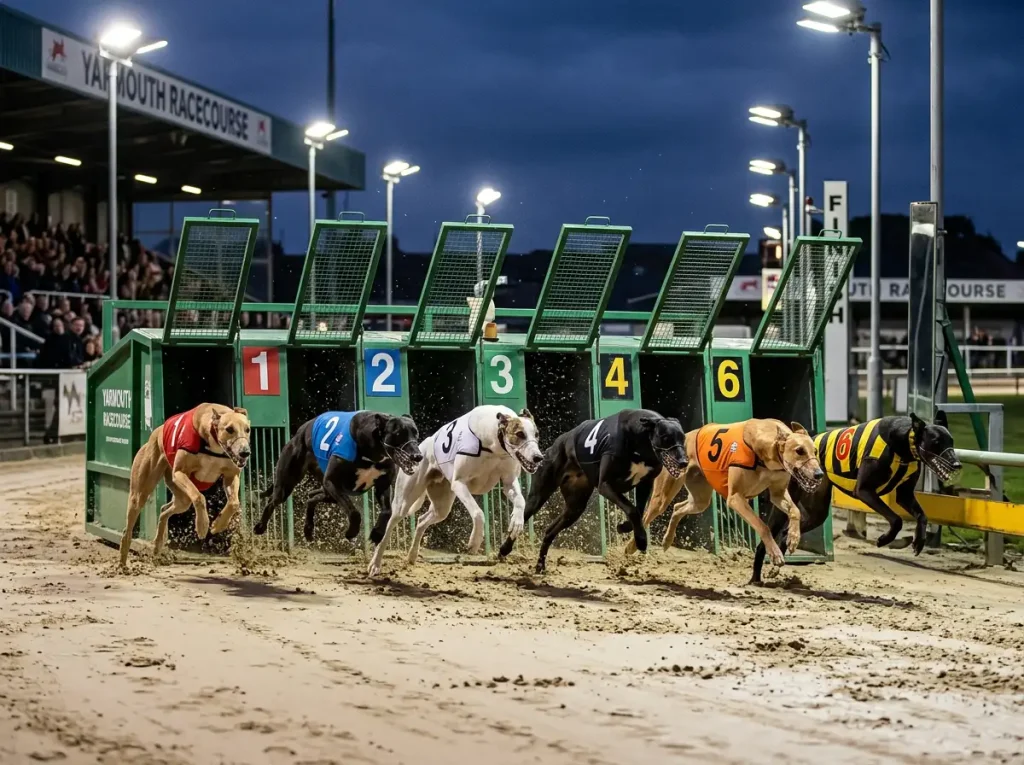
The 277 metres at Yarmouth is over before most spectators have finished their first shout. Two bends, roughly sixteen seconds of flat-out racing, and a result that was almost certainly determined in the first three seconds after the lids flew open. I have always had a soft spot for sprint racing because it strips the sport down to its purest elements: raw speed, clean breaks and trap position. There is no time for tactical recoveries, no distance to make up ground and very little margin for error.
Yarmouth’s sprint distance runs from the standard starting boxes, through an 85-metre run to the first bend, then around two turns to the finish. That 85-metre run-up – the same distance used for the 462m trip – is generous by sprint standards. Some tracks offer significantly less straight before the first turn on their sprint distance, which makes the trap draw even more decisive at those venues. Yarmouth gives sprinters a fraction more time to sort themselves out, but make no mistake: the draw still dominates this trip.
See also: yarmouth dogs results for sprint race results and analysis.
How the 277m Race Works at Yarmouth
Picture the start. Six dogs leave the traps at virtually the same instant, accelerating to close to 40 mph within the first few strides. They have 85 metres of straight track before the first bend. In a 462m race, that straight is a runway – plenty of time for positions to settle. In a sprint, it is the entire opening act. By the time the field reaches the first turn, the race shape is set. Whoever leads into the bend with a clear run is almost certainly going to win, because there are only two bends left and the finish line arrives before any trailing dog can close the gap.
The physics are straightforward. Dogs lose speed on bends because they are fighting centripetal force while maintaining their running line. A leader going into the bend loses less speed than a dog on the outside of the pack, because the leader picks the shortest path and faces no traffic. Over four bends in a 462m race, a trailing dog gets multiple opportunities to close ground on the straights. Over two bends in a 277m sprint, those opportunities simply do not exist. One poor bend, one moment of crowding, and the race is gone.
This is why sprint form at Yarmouth is both easier and harder to read than standard distance form. Easier because the outcome is so dependent on a small number of variables. Harder because those variables – trap draw and break speed – are partially random on any given night. A dog that traps brilliantly in three consecutive sprints and then misses the break once will produce a form line that looks inconsistent, even though its underlying ability has not changed.
Why Trap Draw Is Everything Over 277 Metres
I ran my own numbers on Yarmouth sprints for a full calendar year once, and the results were stark. Trap one won at a rate well above the national average of 18-19%, and the win rate declined with almost mathematical precision as you moved outward to trap six. The inside rail at Yarmouth offers the shortest route around both bends, and over just two turns the cumulative distance saving is enough to decide the race on its own when the dogs are closely matched on raw pace.
But here is the nuance that separates profitable sprint punters from everyone else: trap one does not always contain the fastest breaker. The racing manager assigns trap draws based on the dogs’ running styles and recent form, and sometimes the quickest dog in the field ends up in trap four or five. When that happens, the dynamic shifts. A fast breaker from a wide draw can cross to the rail in the 85-metre straight before the first bend arrives, effectively neutralising the trap advantage. Yarmouth’s longer run-up makes this crossover more achievable than at venues with shorter straights.
The worst-case scenario for sprint punters is a field where two or three fast breakers are drawn next to each other. They leave the traps together, converge on the first bend and interfere with each other, leaving a slower dog on the opposite side of the track to inherit the lead. These messy sprints produce big-priced winners and are almost impossible to predict from the form alone. The antidote is studying the pace profile of every runner and visualising how the break will play out – something I cover in detail in my analysis of Yarmouth race patterns and trap data.
Sprint Times: What Fast and Slow Look Like
The range of winning times over 277m at Yarmouth is narrower than you might expect, precisely because the trip is so short. The difference between the fastest sprint on a card and the slowest is usually less than a second, and within a single grade band you might see a spread of just half a second between the quickest and most moderate winners.
What matters is not the absolute time but the time relative to the going that day. A fast track – dry sand, minimal wind – will produce times across the board that are a few hundredths quicker than a wet or windswept evening. Yarmouth sits on the Norfolk coast, exposed to North Sea weather, and wind has a measurable impact on sprint times. A headwind on the back straight slows every dog in the field, but it slows the leaders fractionally less than the dogs running in their slipstream, which can actually increase the trap-one advantage on windy evenings.
For practical purposes, I keep a running average of 277m winning times at Yarmouth by grade, updated after each meeting. When a dog beats that average by more than 0.20 seconds, it gets flagged for the next card. When a dog runs significantly slower than the average, I check the comments before writing it off – a slow time caused by first-bend crowding is not the same as a slow time caused by a dog that has lost its edge. Sprint times punish you for lazy analysis more than any other distance, because the margins are so thin that a single variable can flip the entire reading.
See also: Yarmouth 462m Results for more details on this topic.
