
Greyhound Weight Changes and Betting: What the Scales Tell You
 Available in US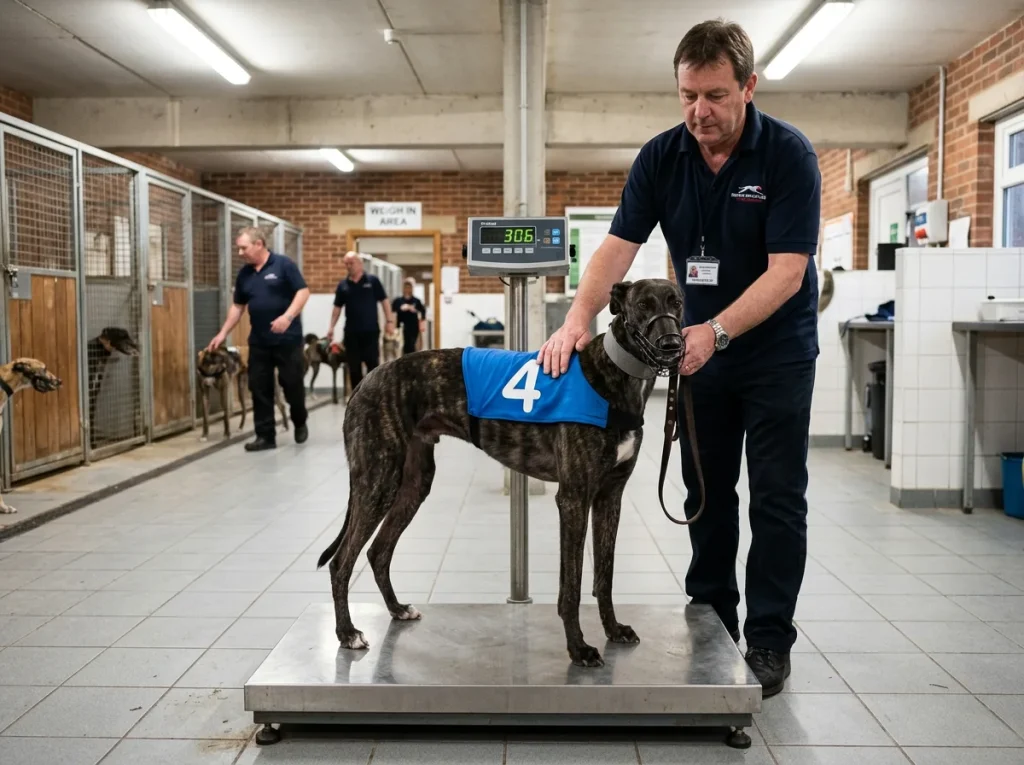
Weight is the most visible piece of data on a greyhound racecard that nobody looks at. I know, because I ignored it for years. The trap draw, the form figures, the winning time – those were the numbers I cared about. The weight column just sat there, a number in kilograms that seemed to convey nothing useful. It took a conversation with a trainer at Yarmouth on a Wednesday morning – one of those casual exchanges between races that sometimes teaches you more than a month of studying data – to make me understand that weight changes are the racecard’s hidden fitness indicator. I have tracked them for every Yarmouth runner since.
Every greyhound is weighed before each race at a licensed UK track. The weight is recorded and appears on the racecard alongside the dog’s form and trap draw. With approximately 6,000 greyhounds registered for racing annually and around 500 trainers managing their condition, the weigh-in data creates a fitness snapshot that updates with every race. The question is whether you are reading it.
See also: yarmouth dogs results and factor in weight changes for betting.
What Weight Data Appears on Yarmouth Racecards
The racecard lists each dog’s current weight – the weight recorded at the pre-race weigh-in for today’s meeting – and usually its weight from the previous race. The difference between the two is the weight change, and it is this change, rather than the absolute number, that carries the useful information.
Greyhound weights vary significantly by breed line, sex and individual build. A typical racing greyhound weighs between 26 and 36 kilograms, with dogs at the lighter end tending to be sprinters and heavier dogs often appearing in the staying races. But the range is wide enough that comparing absolute weights between dogs is meaningless – a 28kg bitch and a 34kg dog can be equally fit, equally fast and equally competitive within their grade. The absolute number tells you about the dog’s frame. The change between races tells you about its condition.
Some racecard formats also show the dog’s weight from two or three runs back, which lets you identify trends rather than just single-race fluctuations. A dog that has lost 0.3kg since its last race has made one change. A dog that has lost 0.3kg per race over three consecutive runs has made a trend, and that trend is information you can use.
Interpreting Weight Increases and Decreases
A small weight loss – up to around 0.5kg – between races is generally a positive indicator. It suggests the dog is being trained hard, kept lean and prepared for peak performance. Trainers who are serious about an upcoming race will often strip a dog of any excess condition in the days before the meeting, and the scales reflect that preparation. A dog running half a kilogram lighter than its last race is, more often than not, a dog that the trainer expects to run well.
A larger weight loss – above 0.5kg in a single interval – needs more scrutiny. It could reflect deliberate conditioning, particularly for a step up in distance where less weight is an advantage. But it could also signal illness, poor appetite or a dog that has not recovered fully from its previous race. Context matters: a 0.8kg loss in a dog whose recent form is strong is less concerning than the same loss in a dog whose form is declining.
Weight increases are the more nuanced reading. A small gain of 0.2 to 0.4kg can indicate a dog that has been rested, fed well and is coming into the race fresh. Some trainers deliberately add a little condition between races for dogs that race frequently, knowing that the dog needs fuel for its effort. A larger gain – above 0.5kg – is more ambiguous. It might mean the dog has been given extra time between races and has put on natural weight, or it might mean the trainer is not confident enough in the dog to prepare it at peak fitness.
The approximately 500 trainers and 3,000 kennel staff working across the registered sector each have their own approach to weight management. Some kennels run their dogs lean and light; others prefer a slightly heavier, more powerful frame. Learning the weight patterns of the major trainers at Yarmouth is an exercise that pays off over time – when you know that a particular trainer always presents dogs half a kilo lighter than their baseline when they expect a big run, a sudden weight drop from that kennel becomes a meaningful signal.
Does Weight Matter More Over Longer Distances?
In theory, weight should matter more over 659m and 843m than over 277m, because the longer the race, the more energy the dog expends carrying every extra gram. In practice, the relationship is not as clean as the physics would suggest, because greyhound racing is not run in a vacuum – the interactions with other dogs, the trap draw, the going and the pace of the race all contribute to the result alongside the dog’s physical condition.
What I have observed at Yarmouth is that weight changes are a stronger signal for dogs stepping up in distance than for dogs repeating at the same trip. A dog that has been running at 462m and is entered at 659m for the first time, and whose weight has dropped by 0.4kg since its last race, is being physically prepared for a stamina test. The trainer is lightening the dog deliberately, which tells you the distance switch is a planned move rather than a desperate experiment.
Conversely, a dog moving down in distance – from 659m to 462m, say – with a weight increase might be a dog whose trainer has decided it lacks the stamina for the longer trip and is reverting to a distance where its power-to-weight ratio is more effective. The weight change accompanies and confirms the strategic decision, giving you a richer understanding of the trainer’s intent than the distance change alone.
Tracking weight alongside every other data point on the Yarmouth racecard – form, trap draw, grade, sectionals – builds a multidimensional picture of each dog’s readiness. No single factor wins races on its own, but each factor adds a layer of probability to your assessment, and weight is one of the layers most punters leave on the table. It fits naturally into the complete analytical process I apply across all Yarmouth racing data, and it begins with knowing how to read the full Yarmouth racecard.
See also: Greyhound Form Guide Yarmouth with relevant background information.
