
Greyhound Trap Draw and Jacket Colours: What Each Box Means at Yarmouth
 Available in US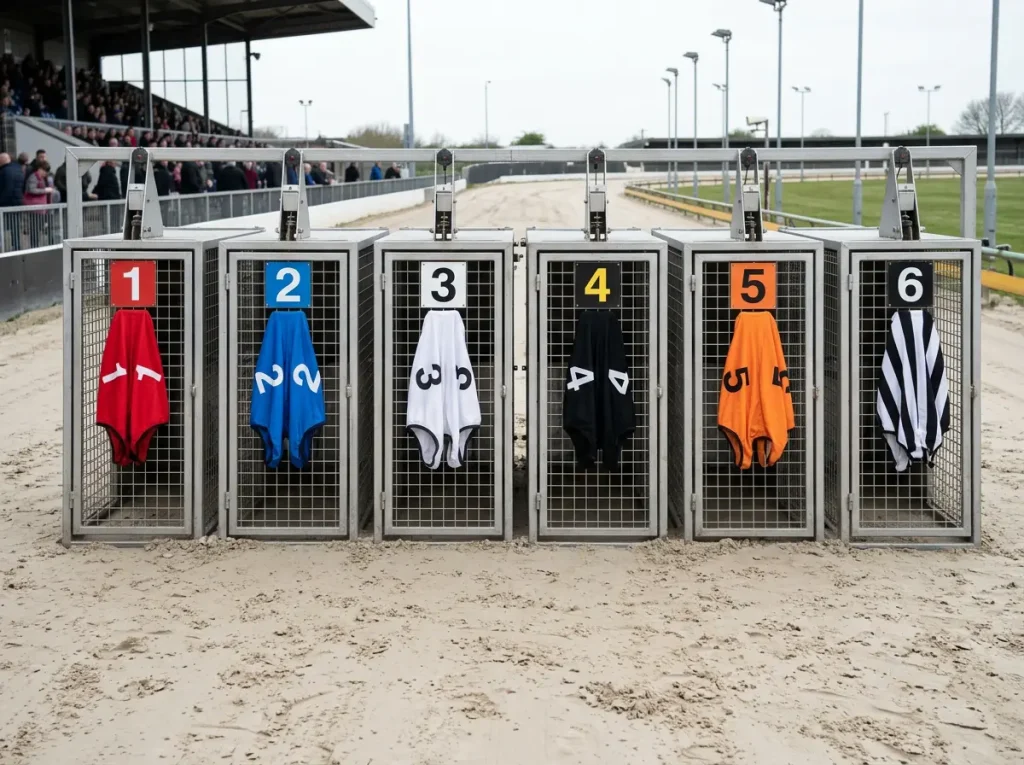
Walk into any greyhound stadium in Britain and the first thing you notice is the colour. Six dogs, six jackets, six starting traps – each one a different colour that has been standardised across every licensed track in the country for as long as anyone can remember. I have been watching greyhound racing for over eleven years, and I still get a small jolt of recognition when I see a red jacket break cleanly from trap one at Yarmouth. The colours are functional – they help spectators and camera operators identify dogs during the race – but they also carry analytical weight that newcomers rarely appreciate.
The trap draw is not a random assignment. It is a deliberate decision by the racing manager, informed by each dog’s running style, and it directly affects the outcome of the race. At Yarmouth, where the 85-metre run to the first bend and the Outside Swaffham hare create a specific bias pattern, understanding what each trap position means is the first step toward reading the racecard with any intelligence.
See also: yarmouth dogs results and learn about trap draw positions.
All Six Traps: Colours, Numbers and Positions
The standard UK trap colours are fixed across all licensed venues. Trap one is red, trap two is blue, trap three is white, trap four is black, trap five is orange, and trap six is black and white striped. These colours are printed on the racing jackets – lightweight fabric vests that the dogs wear over their racing muzzles – and they are visible from anywhere in the stadium. Television broadcasts and online streams also use these colours in their on-screen graphics, so learning to associate each colour with its trap number becomes instinctive after a few meetings.
The trap positions correspond to physical starting boxes arranged in a line across the track. Trap one is closest to the inside rail, trap six is furthest from it. The distance between trap one and the rail, and between trap six and the outside rail, varies by track, but the principle is universal: lower trap numbers are closer to the inside, higher numbers are further out.
At Yarmouth, the starting boxes are positioned so that all six dogs face the first bend with the Outside Swaffham hare running on the outer rail to their right. This means trap one has the shortest path to the first bend – it is already on the rail side – while trap six has the longest path but is positioned closer to the hare’s running line. The dynamics this creates are not immediately obvious, and they play out differently depending on the distance and the speed profile of each runner.
How Trap Position Affects the Race at Yarmouth
The inside-rail advantage is real and measurable. Trap one across all UK tracks shows a win rate of roughly 18-19%, which is meaningfully above the theoretical 16.6% you would expect if every trap had an equal chance. At Yarmouth, the 85-metre run to the first bend gives inside-drawn dogs time to establish their position on the rail before the field compresses into the first turn.
But the advantage is not uniform across all race types. Over the 277m sprint, where there are only two bends and every fraction of a second counts, the inside draw is disproportionately valuable. Over 462m, the advantage softens because the race is longer and there are more opportunities for wider-drawn dogs to find room. Over 659m and 843m, the extended distance means that the first-bend positioning, while still important, is just one factor among several – stamina, pace judgement and bend technique all weigh in alongside the draw.
The Outside Swaffham hare adds another dimension. Because the hare runs on the outer rail, dogs drawn in traps five and six are physically closer to it as they leave the boxes. Some dogs – particularly those with a strong chasing instinct – respond to this proximity by running wider and harder toward the hare, which can work in their favour on the straights but costs them ground on the bends. Other dogs, typically the more experienced racers, ignore the hare’s position and focus on finding the shortest route around the track regardless of their trap draw.
The practical takeaway is that trap draw at Yarmouth is a significant factor but not a deterministic one. A fast breaker in trap one is the statistically most likely winner, but a faster dog in trap four with clean early pace can overcome the draw advantage within the first fifty metres. The combination of trap position and the individual dog’s break speed and running style is what determines the race outcome – and that combination is readable from the racecard if you know what to look for.
How Racing Managers Assign Trap Draws
Trap draws are not random at Yarmouth, and understanding the logic behind the assignment helps you interpret the racecard more accurately. The racing manager allocates traps based on each dog’s known running style, with the aim of producing a safe, competitive race. Dogs that prefer to run on the inside rail – railers – are typically drawn in traps one or two. Dogs that run wide are usually placed in traps five or six. Dogs with no strong preference fill the middle boxes.
This seeding logic means that the trap draw tells you something about the dog even before you look at its form. A dog drawn in trap one has been assessed as a railer by the racing manager, which tells you the dog’s preferred running line. A dog drawn in trap six has been assessed as a wide runner or a dog that benefits from running in open space away from the rail. These assessments are based on the racing manager’s observation of the dog’s previous runs, trials and general behaviour, and they are usually accurate.
Where the system creates opportunity is in the exceptions. Occasionally, the available pool of dogs at a particular grade forces the racing manager to draw a dog in a trap that does not perfectly match its running style. A railer might end up in trap three because traps one and two are occupied by dogs with stronger rail claims. A wide runner might be placed in trap four because there are two other wide runners in the race. These mismatches between running style and draw create situations where the form figures and the draw statistics point in opposite directions – and that tension is often where the best value in the betting market lives.
See also: Yarmouth Trap Stats for more details on this topic.
Studying the trap draw in conjunction with running style, rather than treating it as an isolated statistic, is one of the foundations of the analytical approach I use for all Yarmouth results.
