
Greyhound Sectional Times Explained: How Split Data Reveals Hidden Form
 Available in US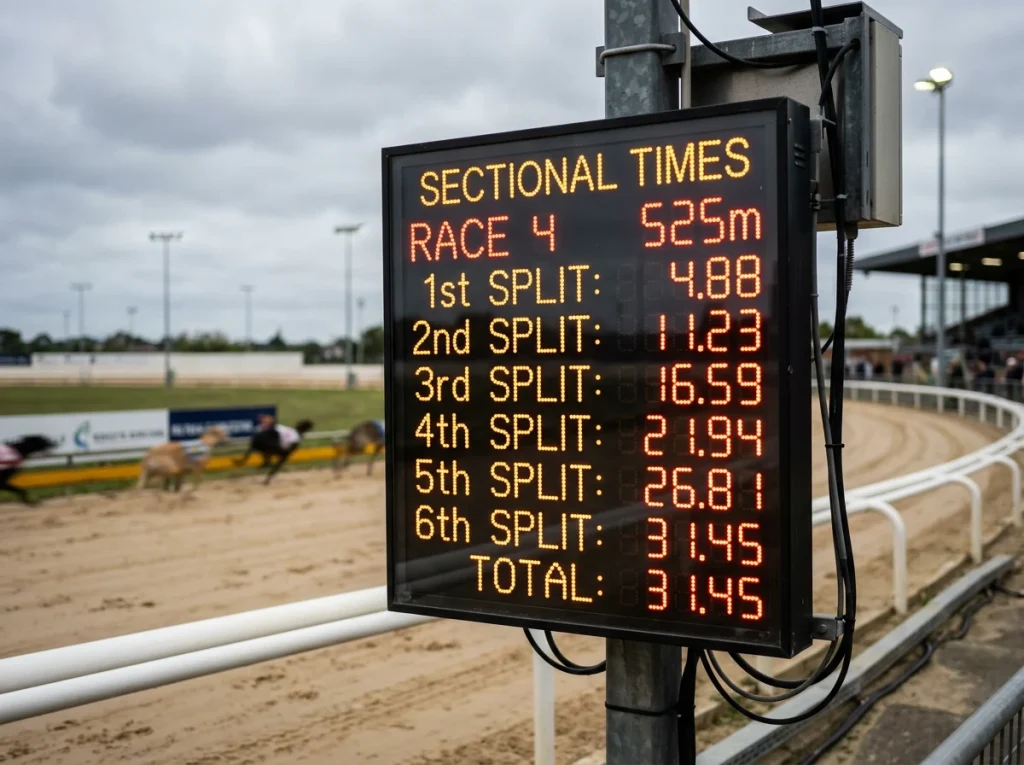
The winning time tells you who crossed the line first. The sectional times tell you why. I learned this distinction the hard way – backing dogs with fast overall times that kept finishing mid-pack, while ignoring dogs with moderate times that were clearly finishing stronger than anything else in the field. Sectional data is the single most revealing layer of greyhound form analysis, and it remains one of the least understood by the average punter. Once you learn to read splits, you will never look at a result the same way again.
At its core, a sectional time measures how fast a dog ran a specific portion of the race, rather than the race as a whole. In a 462m race at Yarmouth – run over a 382-metre circuit with an 85-metre run to the first bend – the overall time might be 29.10 seconds. But that number hides enormous variation in how the race unfolded. A dog might have run the first two hundred metres in 12.00 seconds and the last two hundred and sixty-two metres in 17.10, or it might have split those segments 12.40 and 16.70. Both dogs finished in the same total time, but they ran completely different races – and their prospects next time out are completely different too.
See also: yarmouth dogs results and compare sectional time data.
What Sectional Times Measure
Sectionals break the race into segments, usually defined by the timing equipment at the track. The most common split is between the time to the first bend – the “run-up” sectional – and the time from there to the finish. Some data providers offer more granular splits, dividing the race into three or four segments, though this level of detail is not universally available across all UK tracks.
The run-up sectional is particularly important at Yarmouth because the 85-metre straight from traps to first bend is one of the longer run-ups in the country. A fast run-up sectional means the dog broke cleanly and reached the first bend with early pace. A slow run-up sectional means the dog was slow out of the traps, which at Yarmouth’s 277m sprint distance is almost fatal but at 462m or 659m is recoverable if the closing sectional is strong enough.
The closing sectional – the time from the final bend to the finish line – reveals stamina and racing temperament. A dog that consistently records fast closing sectionals relative to its field is either a natural closer or a dog with untapped reserves that the overall time does not reflect. This is the hidden form that sectional data exposes. A dog might finish third in a 462m race with an overall time of 29.30, which looks mediocre. But if its closing sectional was the fastest in the field by a clear margin, that dog was running on strongly at the finish and was probably unlucky not to place higher.
Calculated Splits vs Official Sectionals
Here is where it gets practical, and slightly complicated. Not every track publishes official sectional times, and even where they are available, the format and granularity vary between venues and data providers. Yarmouth’s official results include an overall winning time and distances between finishers, but detailed sectionals are not always part of the standard published data.
This is where calculated splits come in. By using the distances between finishers at the line and applying some basic arithmetic, you can reverse-engineer approximate sectionals for any dog in the race. If the winner ran 29.00 and the second dog finished two lengths behind, you can estimate the second dog’s time at approximately 29.12 (using a rough conversion of one length equals 0.06 seconds, though this varies with the dogs’ speed at the finish). Extending this calculation across the full field gives you a set of estimated finishing times, and comparing those with each dog’s estimated time to the first bend lets you derive approximate sectionals.
The calculations are not perfectly precise – a length is not a fixed time unit because dogs decelerate at different rates – but they are accurate enough to identify the key patterns. A dog whose calculated closing split is consistently stronger than its opening split is a finisher. A dog whose opening split is fast but whose closing split is weak is a front-runner that ties up. These patterns hold up across multiple races, which means calculated sectionals are a reliable analytical tool even when official data is unavailable.
Reading Sectionals to Spot Improving Dogs
This is the payoff – the reason sectional analysis matters for your selections. Favourites nationally win around 35.67% of graded races, which means the market gets it wrong nearly two-thirds of the time. Much of that error comes from the market relying too heavily on finishing positions and overall times, which are the most visible data points on the result card. Sectional data sits underneath that surface and reveals dogs whose form is better or worse than the headline figures suggest.
An improving dog shows a specific sectional signature: its closing splits are getting faster relative to its field over its last three or four runs, even if its finishing position has not changed. Maybe it has finished fourth in its last three races, which looks like poor form. But if its closing sectional has improved each time – from the slowest in the field to the second fastest to the fastest – that dog is on an upward trajectory that the form figures completely obscure. When it finally gets a clean run to the first bend and avoids early trouble, the closing speed will carry it to a winning position, and the market will be surprised because it was fixated on the form figure of “4-4-4”.
The opposite pattern flags dogs to avoid. A dog whose closing sectional is deteriorating race by race is a dog that is losing its edge, even if it is still winning. I have seen dogs win three consecutive races with progressively weaker closing splits, each victory narrower than the last, and then lose their next start as a short-priced favourite because the underlying form had been declining for weeks. The punters who backed the favourite saw three wins and assumed the trend would continue. The punters who tracked the sectionals saw a dog running on fumes.
Building this kind of sectional picture for Yarmouth runners takes time and a simple tracking system – a spreadsheet is more than sufficient. The investment pays for itself quickly, and it connects directly to the broader approach of interpreting Yarmouth results beyond the surface numbers.
See also: Yarmouth Trial Times for more details on this topic.
