
Greyhound Betting Odds Explained: SP, BSP and How Prices Form
 Available in US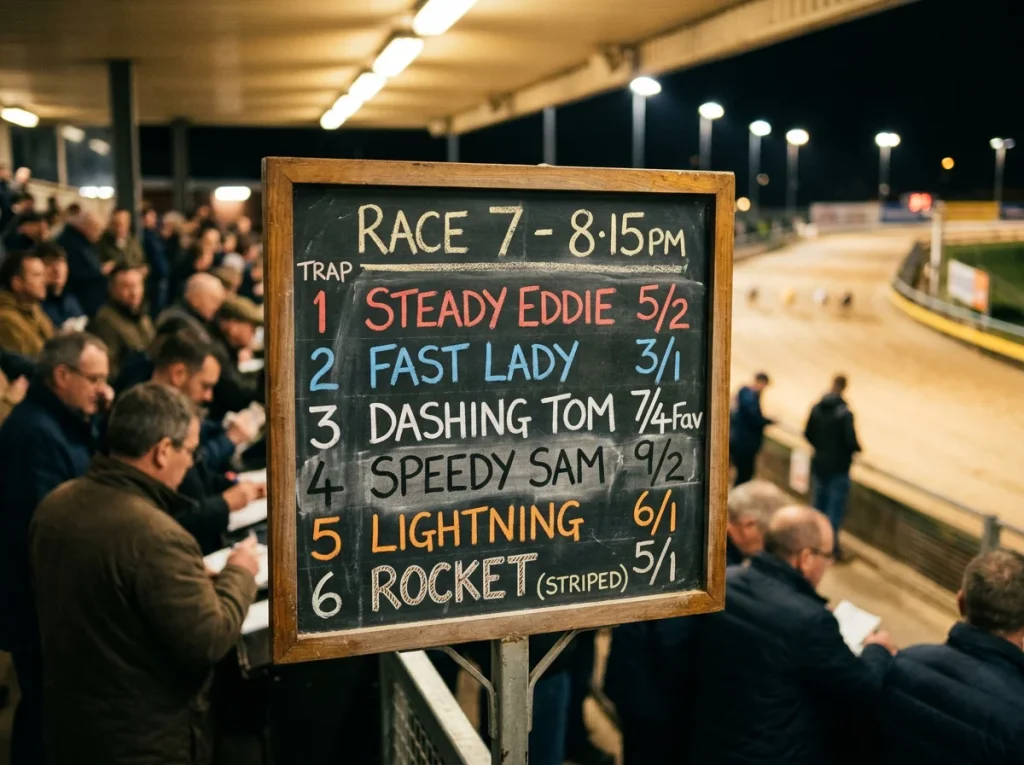
I spent my first year betting on greyhounds without understanding how the prices I was taking were actually created. I knew that 3/1 paid more than evens, and I knew that shorter prices meant the dog was fancied – but I had no idea why a dog opened at 5/2 on the morning boards and went off at 7/4 by race time, or what the difference was between the price I took and the official starting price recorded in the results. That ignorance cost me money in ways I did not recognise until I finally sat down and learned how the pricing mechanism works.
The UK greyhound betting market turns over £794 million annually through bookmakers, and over 70% of that volume now comes through mobile platforms. The prices you see on your phone are the output of a complex system involving bookmaker risk models, market liquidity, exchange activity and the weight of money from thousands of individual punters. Understanding how that system operates does not guarantee profit, but it removes one of the most common sources of loss: taking bad prices because you did not know a better one was available.
See also: yarmouth dogs results for a beginner’s guide to greyhound odds.
How Greyhound Odds Are Set and Move
Greyhound prices for BAGS meetings like those at Yarmouth are typically set by bookmaker trading teams on the morning of the meeting, once the final declarations and trap draws are confirmed. The opening prices – sometimes called “tissue” prices – are the bookmaker’s initial assessment of each dog’s chance, based on form, grade, trap draw and the competitive profile of the field.
These opening prices are not predictions of the result. They are starting positions in a negotiation with the market. As money comes in on specific dogs, the prices move. A dog that attracts heavy early backing will shorten – its odds decrease, reflecting the market’s assessment that it is more likely to win. A dog that nobody bets on will drift – its odds lengthen, suggesting the market sees it as a weaker contender.
The mobile revolution has compressed this process. A decade ago, prices moved slowly over the course of the afternoon as bets trickled in through betting shops. Now, with over 70% of greyhound wagers placed via mobile, price movements happen faster and are driven by a larger, more geographically dispersed pool of bettors. A dog can open at 3/1 at 10am and be 2/1 by the time the traps open at 11:30 if the early money is one-directional.
For the form student, price movements are data. A significant shortening that you did not expect – a dog you assessed as a 5/1 chance being backed into 5/2 – tells you that someone with information or conviction you lack is putting money down. That does not mean they are right, but it means something in the market is disagreeing with your assessment, and it is worth understanding why before the race goes off.
Starting Price vs Betfair Starting Price
The Starting Price – the SP – is the official price recorded in the result at the moment the race begins. It is determined by the on-course bookmakers’ boards at the track, and it is the price you receive if you take SP rather than a fixed price when placing your bet. For most BAGS meetings at Yarmouth, the SP is the fallback price that bookmakers settle at if you have not taken a specific fixed-odds price before the off.
The Betfair Starting Price – the BSP – is a completely different mechanism. It is the price calculated by the Betfair exchange at the moment the race starts, based on the matched and unmatched bets in the exchange market. BSP is determined by supply and demand between backers and layers on the exchange, rather than by bookmaker risk management. The two prices can differ significantly, and the direction of the difference tells you something about where the “smart” money is positioned.
When the BSP is shorter than the SP, it typically means exchange punters – who tend to be more data-driven and form-literate than the average betting-shop customer – have assessed the dog’s chance more favourably than the traditional market. When the BSP is longer than the SP, the exchange market is less impressed than the bookmaker market. Tracking the BSP-to-SP differential over time for Yarmouth meetings builds a picture of which dogs the sharper market consistently values differently from the general public.
I record BSP and SP for every race I follow at Yarmouth. Over hundreds of races, the patterns become clear: certain trainers’ dogs consistently attract exchange money, certain trap draws are systematically overpriced by the traditional bookmaker market, and certain grade bands produce bigger BSP-to-SP gaps than others. None of these patterns are guaranteed profit sources on their own, but layered together they create an informational advantage that compounds over time.
What Price Movements Tell You Before a Race
There is a specific sequence I watch for in the fifteen minutes before a Yarmouth race goes off, and it has become one of my most reliable pre-race indicators. If a dog shortens steadily from its opening price – not a single lurch but a consistent drift inward over the last quarter of an hour – that dog is attracting sustained, informed money. The shortening is not caused by one large bet but by multiple bettors independently reaching the same conclusion, which is a stronger signal than a single large gamble that might reflect one person’s hunch.
Conversely, a dog that drifts in the final minutes – lengthening from its opening price without any obvious market activity on another dog – is being abandoned by the informed market. This can happen when late information emerges: a dog looked slow in the pre-race parade, or word circulates that the dog missed its last trial. You will not always know the specific reason, but the price movement is the market’s aggregated assessment, and it is usually worth respecting.
The trap I fell into early in my betting life was reacting to every price movement as if it were gospel. Not every shortening means the dog will win, and not every drift means it will lose. Price movements are probabilistic signals, not certainties. They are most useful when they confirm an assessment you have already made from the form – if your analysis says a dog is value at 3/1 and the market agrees by backing it in to 2/1, you have alignment between your private assessment and the collective market intelligence. That alignment is the closest thing to confidence that greyhound betting offers, and it is a core part of how I approach selections at Yarmouth, alongside the broader data-led betting framework I use for every meeting.
See also: Forecast Bet Explained with additional insights and data.
