
Greyhound Form Guide for Yarmouth: How to Read and Rate Recent Runs
 Available in US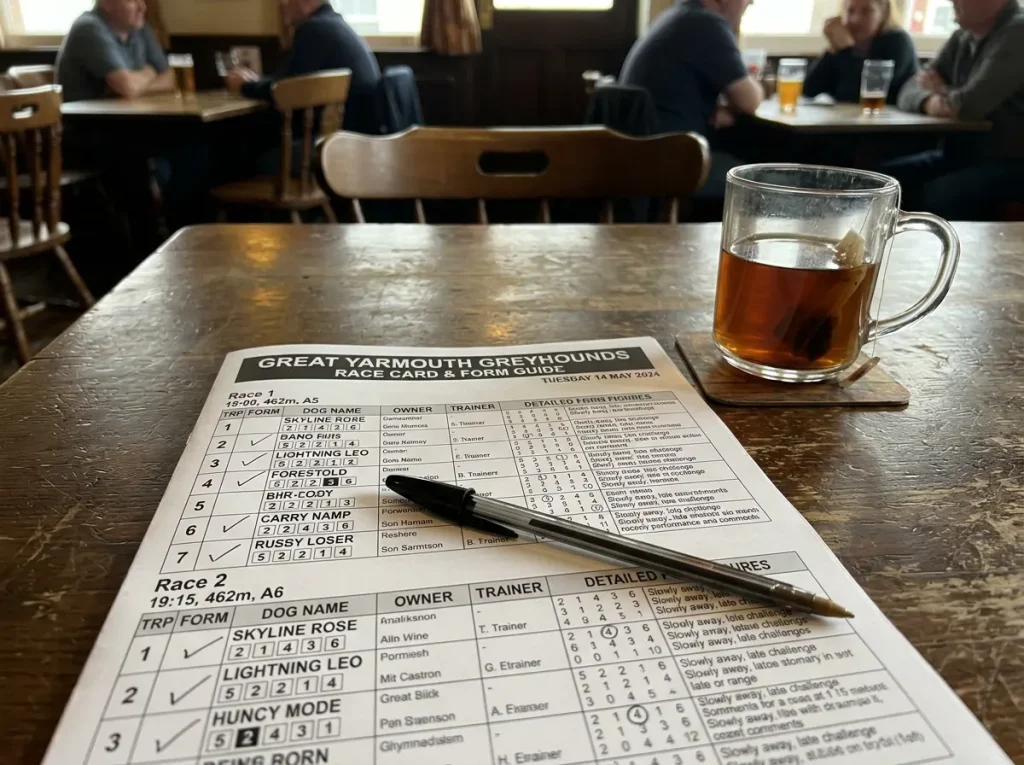
I keep a notebook beside me every time I study a Yarmouth card, and the first thing I write down for each race is not the dogs’ names or their trap draws – it is the form figures. Those short strings of numbers next to each dog’s name are the compressed history of its recent racing life, and they are simultaneously the most useful and most misunderstood piece of information on the racecard. A form figure of “1-2-1” looks brilliant. A form figure of “5-6-4” looks dismal. But either reading can be completely wrong without the context that sits behind the numbers.
Form figures are the foundation of greyhound analysis, and at Yarmouth – where BAGS meetings produce a constant stream of data across three or four meetings a week – the ability to read form accurately separates the profitable punters from the ones who wonder why their “obvious” selections keep letting them down.
See also: yarmouth dogs results for detailed form guides and analysis.
What the Numbers and Letters in Form Mean
Each number in a form string represents the dog’s finishing position in one of its recent races, reading from left to right with the most recent result first. So “2-1-3” means the dog finished second last time out, won the time before that, and finished third the race before. Most racecards display the last six runs, though some sources show fewer.
Letters appear in place of numbers when a race produced an unusual outcome. “W” indicates the dog won by a wide margin, sometimes used instead of “1” for emphatic victories. “D” means the dog was disqualified, which happens most commonly for interference. “M” indicates a moved race – the dog was withdrawn from its original race and moved to a different one. Other letters you might encounter include “F” for fell, “T” for a trial run rather than a competitive race, and various codes that indicate the dog did not finish for reasons ranging from injury to running off the track.
Nationally, favourites win around 35.67% of graded races, but the form figures are what the market uses to identify those favourites. A dog with a form string dominated by 1s and 2s will be shorter in the betting than a dog showing 4s and 5s, regardless of whether those numbers tell the true story. The gap between what the form figures say and what they actually mean is where the value lives.
Why Finishing Position Needs Context
Here is a scenario I encounter at Yarmouth almost every week. Dog A shows form of “1-1-2” – three strong recent runs, clearly in good form. Dog B shows “4-5-3” – looking out of sorts, right? Not necessarily. Dog A earned those form figures in A8 races against slow opposition and has just been promoted to A6. Dog B earned its figures in A4 races against much faster dogs and has been demoted to A6. They are now meeting in the same race, and Dog B’s “poor” form was actually earned against competition two grades above what Dog A has been facing.
Grade context is the single most important adjustment when reading form at Yarmouth. The 382-metre circuit hosts races from roughly A3 down to A9, and a finishing position in a higher grade carries more weight than the same position in a lower grade. A dog that finishes third in an A3 race might well be capable of winning an A5 comfortably, but the form figure shows “3” in both cases, and the market treats them equally if you do not look deeper.
Distance context is the second adjustment. Form figures earned over 462m do not automatically transfer to 277m or 659m. A dog that wins regularly over the standard distance might struggle at the sprint because it lacks early pace, or it might not stay 659m because it runs out of stamina. The form figure says “1” but the question is whether that win was earned at a distance that is relevant to today’s race. I always check which distance each form figure was earned over before I assess it – a habit that takes thirty seconds per dog and prevents the most common errors in form reading.
When Recent Form Should Be Ignored
This is the contrarian section, and I suspect it will be the most useful one. There are specific circumstances where recent form at Yarmouth should be downgraded or ignored entirely, and recognising those circumstances is a skill that comes with experience.
First: form earned on unsuitable going. If a dog’s last three runs were on fast going and today’s card is running on rain-softened sand, those form figures may not be representative. Some dogs handle soft going better than others, and a string of wins on quick surfaces does not guarantee the same performance in the wet. This is particularly relevant at Yarmouth, where coastal weather conditions can shift significantly between meetings.
Second: form earned after a layoff. A dog returning from injury or a break from racing often needs a run or two to regain peak fitness. Its first race back might produce a form figure of “5” or “6”, which looks poor but simply reflects ring-rustiness rather than a decline in ability. Experienced Yarmouth punters know to note the date of each form run and treat any figure earned on a first start after a gap of three weeks or more with caution.
Third: form distorted by trouble. A dog that was badly crowded on the first bend, interfered with on the back straight or checked by a falling rival will produce a form figure that has nothing to do with its ability. The race comments – “slow away”, “crowded first bend”, “baulked third bend” – are the diagnostic tool here. I flag any dog that had a troubled run and mentally upgrade it by one or two positions for the purpose of assessing its true form level. That mental adjustment frequently identifies dogs that are underpriced at the next meeting because the market only sees the poor form figure.
Developing a complete form-reading process for Yarmouth takes time, but every element described here connects to the broader analytical framework I apply to Yarmouth results – it is not a standalone exercise but part of a systematic approach to the track.
See also: Greyhound Early Pace Rating for practical tips and examples.
