
Greyhound Forecast Bet Explained: Exactas, Tricasts and When to Use Them
 Available in US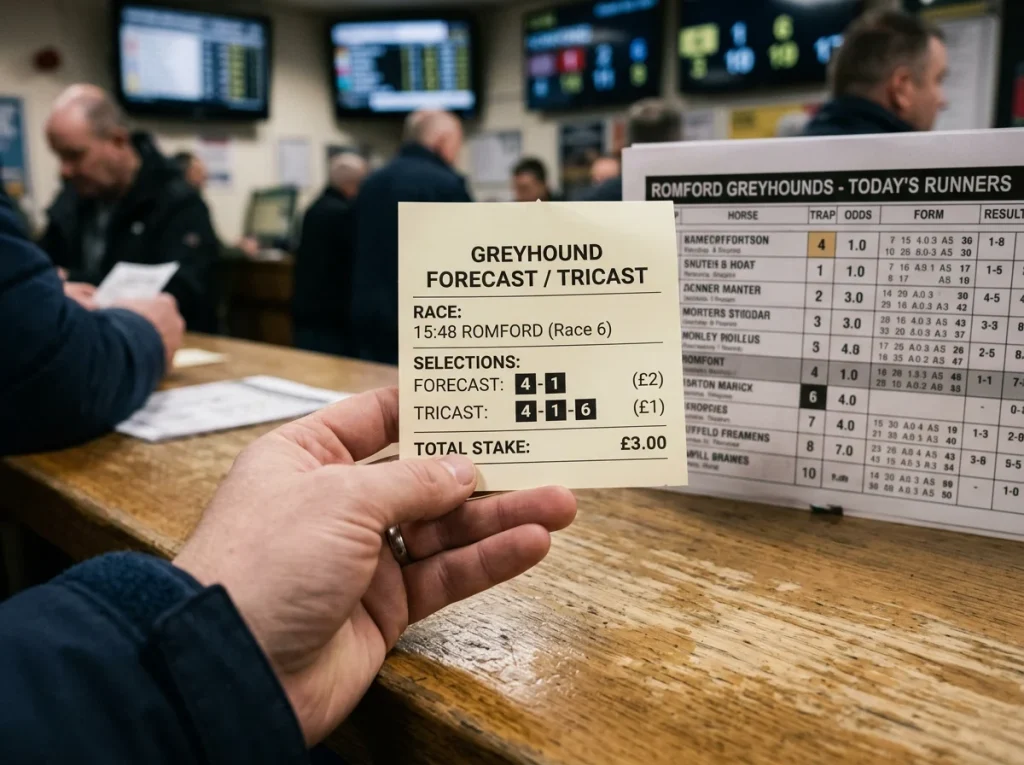
The first forecast bet I ever landed at Yarmouth paid just over £40 from a £2 stake. It was a Monday afternoon A6 race, two dogs I fancied but neither of which I trusted enough to back outright. So I paired them in a straight forecast – first and second in the correct order – and when they obliged by running to form while the favourite stumbled on the first bend, I collected a return that a single win bet would never have produced. That was the moment I understood why forecast and tricast bets exist: they let you express a more detailed opinion about a race and get paid accordingly.
Greyhound racing generates a betting turnover of £794 million through bookmakers in the 2023-24 financial year, and a significant portion of that figure comes from exotic bets rather than simple win wagers. Forecasts and tricasts are the bread and butter of greyhound exotics, and understanding how they work – and when they offer genuine value – is an essential skill for anyone serious about the sport.
See also: yarmouth dogs results for forecast and tricast bet guides.
Straight, Reverse and Combination Forecasts
A straight forecast is the simplest version: you name the first and second finisher in the exact order. Get both right, and you collect. Get them the wrong way round, and you lose. The payout is calculated by the tote pool or the bookmaker’s own formula, and it is typically much larger than a win bet on either individual dog because you are predicting a more specific outcome.
The reverse forecast covers both permutations – your two selections finishing first and second in either order. It costs twice the stake of a straight forecast because it is effectively two bets, but it removes the need to predict which of your two fancied dogs finishes in front of the other. For anyone who has sat through the experience of watching their two selections fill the first two places only to discover they picked the order wrong, the reverse forecast is a sanity-preserving option.
Combination forecasts extend the principle further. You select three or more dogs and cover every possible first-and-second permutation between them. With three dogs, that is six permutations – six individual straight forecasts – so the cost is six times the unit stake. With four dogs, it jumps to twelve permutations. The mathematics escalate quickly, which is why combination forecasts work best when you are confident that two or three specific dogs will fill the places but cannot separate them. Selecting every dog in the field is possible but defeats the purpose – the cost eats into the return and you are no longer expressing a meaningful opinion.
I use straight forecasts when I have a strong view on the winner and a secondary selection for second. I switch to reverse forecasts when two dogs look clearly superior to the rest of the field but I cannot confidently rank them. Combination forecasts come out when a race looks wide open among three or four contenders and I want coverage without committing to a specific finishing order.
The Tricast: How Three-Dog Bets Work
Tricasts take the forecast concept and add a third dimension: you predict the first, second and third finisher. A straight tricast requires all three in the exact order. A combination tricast covers every permutation of your selected dogs finishing in the first three positions.
With three dogs in a combination tricast, there are six permutations – the same as a three-dog combination forecast, but now for the first three places rather than the first two. The payouts on tricasts are substantially larger than forecasts because the specificity of the prediction is much higher. Landing a straight tricast on a race where the result defies the market can produce returns of several hundred pounds from a modest stake.
The challenge with tricasts is that predicting three finishing positions in a six-dog field is inherently harder than predicting two. In a race where the form points clearly to two dogs but the third place is wide open, a tricast is a lottery ticket dressed up as analysis. I only play tricasts when I have a genuine view on all three placed positions – which, in practice, means I play them far less often than forecasts. The temptation to tricast every race because the payouts look attractive is one of the fastest routes to an empty bankroll in greyhound betting.
When Forecasts and Tricasts Offer Value at Yarmouth
Not all races are created equal for exotic bets, and Yarmouth’s card structure creates specific opportunities. Favourites win approximately 35.67% of graded races nationally, which means the favourite is beaten nearly two-thirds of the time. In races where the favourite is short-priced – 4/6 or shorter – the win bet offers thin value, but a forecast or tricast that includes the favourite alongside a bigger-priced second or third selection can transform the return.
The ideal forecast race at Yarmouth has a strong favourite that you expect to win but a second place that is genuinely open. Instead of backing the favourite at a price that barely covers your stake, you pair it in a straight forecast with the dog you think will chase it home. If the favourite obliges and your second pick fills the place, you collect a payout that reflects the difficulty of predicting the exact order – typically several times what a win bet would have returned.
Conversely, the worst races for forecasts are the ones where the result is wide open across the entire field. If any of the six dogs could plausibly win, covering enough permutations to have a realistic chance of landing the forecast costs so much that the return barely justifies the outlay. In those races, a simple each-way or win bet on your best selection is more efficient.
Yarmouth’s BAGS meetings throw up both types regularly. The graded fields are designed to be competitive, but grade bands are not precision instruments – you will see races where one dog is clearly superior and races where the entire field is evenly matched. Learning to distinguish between the two before the off, and adjusting your bet type accordingly, is a skill that develops with experience and one that connects directly to the broader approach of analysing Yarmouth race data systematically.
See also: Greyhound Staking Plans for more details on this topic.
