
East Anglian Derby Results: History, Format and Winners at Yarmouth
 Available in US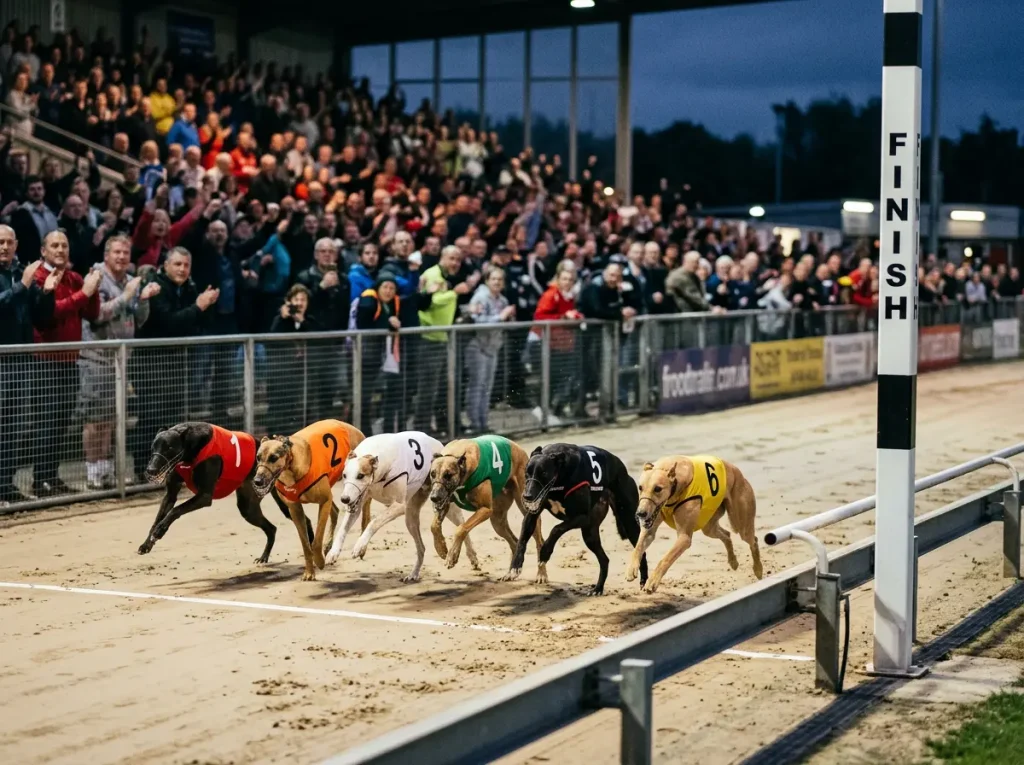
There is a moment during every East Anglian Derby final when the noise at Yarmouth lifts to a level you simply do not hear on a regular Monday BAGS card. The stadium fills beyond its usual crowd, the tote windows are three deep, and the six dogs in the traps represent the best 462m runners that the region – and often the country – can offer. I have attended the Derby more times than I can count, and it remains the single event that reminds me why I fell in love with greyhound racing in the first place.
The East Anglian Derby has been Yarmouth’s flagship competition since 1947, making it one of the longest-running named competitions in the sport. Run over the standard 462 metres, it carries prize money that dwarfs the weekly graded purses – the 2021 winner took home £15,000 – and it draws entries from kennels that rarely trouble the regular Yarmouth card.
See also: yarmouth dogs results with all major race results at Yarmouth.
How the East Anglian Derby Works
The Derby follows a knockout format that begins with heats and progresses through semi-finals to a six-dog final. The heats are typically run over several meetings, with the fastest qualifiers advancing. Seedings and trap draws for the later rounds are determined by heat performances, which means the form generated during the early rounds becomes the primary analytical tool for the semi-finals and final.
What makes the Derby different from weekly graded racing is the entry criteria. Graded races at Yarmouth are populated from the resident pool of dogs registered at the track, and the racing manager assigns traps and grades based on recent form at the venue. The Derby, by contrast, is an open competition. Dogs from other tracks can enter, which means the final might feature runners with form lines from half a dozen different venues. Reading that form requires an understanding of how times compare between tracks – a 28.60 at Yarmouth does not mean the same thing as a 28.60 at a different 462m circuit, because track geometry, surface conditions and hare systems all affect the clock.
The 462m distance at Yarmouth features a 382-metre circuit with an 85-metre run to the first bend, chasing an Outside Swaffham hare. Derby entrants that have raced primarily at tracks with shorter runs to the first bend or different hare positions may need an adjustment period, and the heat rounds serve partly as acclimatisation runs for visiting dogs. I have noticed over the years that locally trained dogs tend to perform disproportionately well in the heats, where track familiarity counts, while the visiting dogs often improve into the semi-finals and final once they have had a run or two on the surface.
The heat times are worth studying carefully, because they set the benchmark for the rest of the competition. A dog that qualifies with the fastest heat time across all rounds has announced itself as the one to beat, and the market will price it accordingly in the semi-finals. But a dog that qualifies with a moderate time after encountering trouble on the first bend may be hiding a faster performance – and that hidden ability is where the value sits in the later rounds.
Notable Winners Through the Decades
The Derby’s history stretches back almost eighty years, and its roll of honour reads like a timeline of the sport’s evolution in East Anglia. In the earlier decades, the competition was dominated by local kennels with deep roots in the Norfolk greyhound community. Dogs were bred, reared and trained within a few miles of the stadium, and the Derby was the pinnacle of a regional circuit that sustained dozens of smaller meetings across the county.
As the sport consolidated through the late twentieth century – with 91 licensed NGRC stadiums closing between 1960 and 2010 – the Derby increasingly attracted dogs from further afield. National trainers began to view the competition as a stepping stone for promising dogs, and the quality of the field deepened accordingly. The prize money grew to reflect this: from relatively modest sums in the post-war era to the £15,000 first prize that makes it one of the more valuable regional derbies on the circuit.
2026 marks the centenary of greyhound racing in Britain – the first race was held at Belle Vue Stadium in Manchester on 24 July 1926 – and GBGB Chairman Sir Philip Davies has spoken of the sport celebrating its hundredth year. Within that centenary, the East Anglian Derby occupies a specific place: a competition that has survived every wave of stadium closures, commercial restructuring and regulatory change, and continues to define Yarmouth’s identity as a racing venue.
How the East Anglian Derby Compares to National Derbies
In the hierarchy of UK greyhound competitions, the English Greyhound Derby sits at the summit with prize money of £175,000 for the winner – more than ten times the East Anglian Derby purse. Below that, a tier of Category One and Category Two races fill the open competition calendar, with GBGB scheduling 50 Category One and 27 Category Two events for the centenary year. The East Anglian Derby sits comfortably within this structure as one of the established regional derbies that provide a competitive pathway for dogs below the very top tier.
The comparison matters for form analysis. A dog that reaches the East Anglian Derby final is a high-class performer by Yarmouth standards, but it may or may not be competitive at national category level. When a Derby finalist returns to regular graded racing at Yarmouth, the market sometimes overprices it – expecting Derby-level performance in an A3 race, when in reality the dog ran its peak effort in the final and may need a few weeks to recover. Conversely, a dog that went out in the Derby heats and subsequently drops back into graded company might be underpriced, because the heat form was generated against competition far superior to its regular grade.
For punters who follow Yarmouth year-round, the Derby period creates a disruption in the regular grading cycle. Dogs are withdrawn from graded racing to compete in the Derby rounds, then return to the weekly cards at various points. Tracking which dogs participated in the Derby, how far they progressed and how they performed relative to their grade is one of the more productive post-Derby exercises – and it feeds directly into the kind of detailed Yarmouth results analysis that separates the serious form students from the casual followers.
See also: Greyhound Racing Centenary 2026 with additional insights and data.
