
Yarmouth Dog Track: Stadium Guide, Facilities and Visitor Information
 Available in US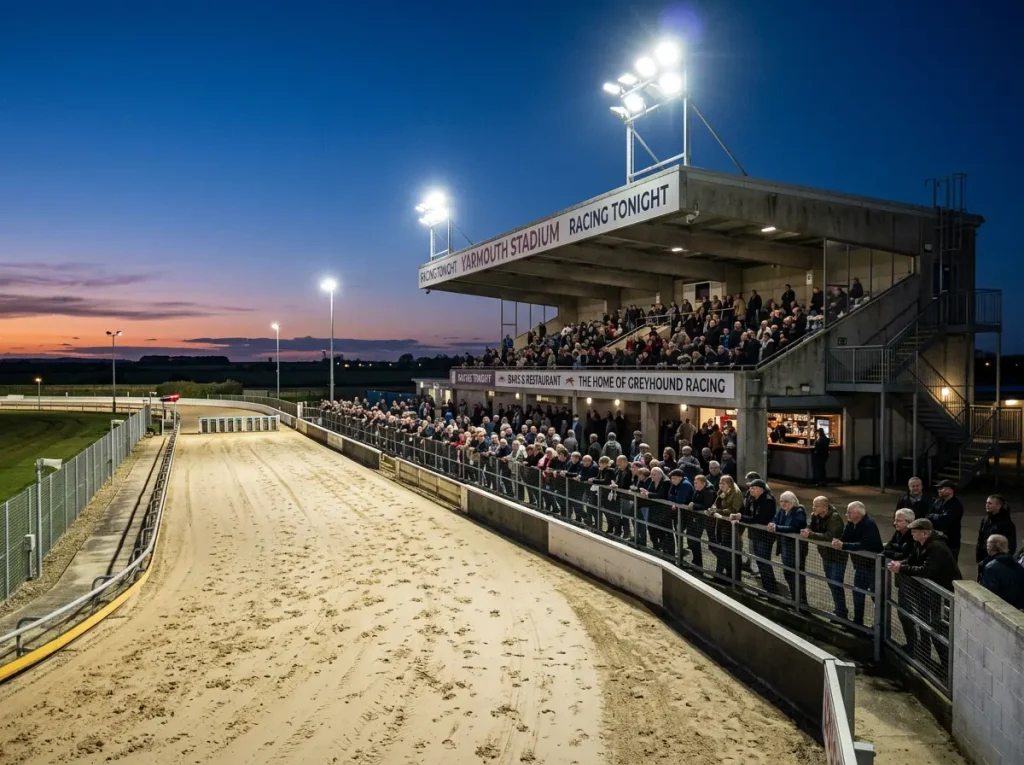
The first time I drove to Yarmouth Stadium, I missed the turning. The sat-nav sent me through Caister-on-Sea on the A149 and I sailed right past the entrance because I was expecting something grander. Yarmouth doesn’t announce itself with floodlit towers or motorway signage. It sits on Yarmouth Road in Caister, a compact venue tucked between the Norfolk coast and the suburban fringe of Great Yarmouth, and you’ll find it by postcode — NR30 5TE — rather than by landmark.
That understated first impression is deceptive. Yarmouth Stadium holds more than 5,800 spectators, has parking for roughly 1,000 cars, and runs a fixture list that makes it one of the busiest greyhound venues in the east of England. It’s not a purpose-built arena from the modern era; it’s a working track with nearly a century of history, a practical layout designed for racing rather than spectacle, and the kind of atmosphere that comes from a venue where the staff know the regulars by name.
This guide covers everything a visitor needs — whether you’re planning your first trip to the dogs or you’re a regular who’s never explored what’s beyond the trackside rails. I’ll walk you through getting there, what’s inside, how a race night unfolds, and the history that makes this place more than just a stretch of sand and a set of starting boxes.
See also: yarmouth dogs results for a complete guide to Yarmouth greyhound racing.
Getting to Yarmouth Stadium: Address, Parking and Transport
Yarmouth Stadium sits on Yarmouth Road in Caister-on-Sea, within the Borough of Great Yarmouth, Norfolk. The postcode NR30 5TE will get any sat-nav within sight of the entrance. If you’re driving from Norwich, the A47 dual carriageway runs east to the Great Yarmouth bypass, then the A149 takes you north through Caister. From the Midlands or further north, the A47 is still your route — it feeds directly into the Yarmouth road network without needing to navigate the town centre. From London and the south, the A12 to Lowestoft and then the A143/A47 corridor is the most direct path, though it’s not fast — budget three hours minimum from the M25.
Parking is not a problem. The stadium grounds include space for approximately 1,000 vehicles, and I have never arrived to find it full, even on a Saturday evening card. The car park is unstructured — essentially a large open area adjacent to the stadium — but it’s flat, accessible, and free of the circuitous one-way systems that make parking at some London venues a blood-pressure event. Arrive half an hour before the first race and you’ll park within a two-minute walk of the entrance.
Public transport is less straightforward. Great Yarmouth railway station is served by trains from Norwich (roughly 30 minutes), and from there a local bus or taxi will cover the three miles to Caister. The bus service along the A149 corridor passes close to the stadium, but frequencies are limited in the evening, which makes the return journey after a Saturday night meeting unreliable unless you’ve checked the timetable in advance. My honest advice: if you’re coming for an evening card, drive or pre-book a taxi. The public transport works for daytime BAGS meetings but gets thin after about nine o’clock at night.
For visitors combining the dogs with a Norfolk holiday — and in summer plenty of people do exactly that — Caister-on-Sea sits between Great Yarmouth’s seafront and the Broads National Park. The stadium is a ten-minute drive from the seafront amusements and about twenty minutes from the closest Broads waterways. It’s not a destination venue in the way that a London track might be, but as part of a broader Norfolk trip, it slots in neatly.
Inside the Stadium: Bars, Raceview Restaurant and Terraces
Step through the turnstiles and the first thing you’ll notice is that Yarmouth is a stadium built for function rather than flash. The main grandstand offers covered seating with a direct view of the home straight and the first bend. Below the stand, trackside terracing lets you get close enough to feel the sand kick up as the dogs pass. In colder months, the covered areas fill up first; in summer, the trackside spots are preferred because there’s more room to move and the evening light over the Norfolk coast is worth the standing.
The Raceview Restaurant is the stadium’s premium offering, seating 240 guests at tables overlooking the track. Meals are served before and during the racing, and the format is typically a set menu tied to the meeting. The restaurant caters primarily to group bookings — birthday parties, corporate events, stag and hen nights — and it fills up on Saturdays, so booking in advance is essential for evening meetings. For the casual visitor, the standard admission gives you access to the trackside bars and food counters, which serve the usual stadium fare: burgers, chips, pies, and a decent enough selection of drinks. It’s not fine dining, but it’s hot and it’s quick, and on a cold Norfolk evening that’s what matters.
The betting facilities include on-course tote windows and bookmaker pitches along the trackside rails. For punters who prefer to bet on their phones, the mobile signal at Yarmouth is generally reliable — I’ve never had trouble placing bets through apps while at the track, which is more than I can say for some venues in built-up urban areas where the signal gets congested. There are television screens throughout the stadium showing live coverage of the racing, the racecard information, and results from other meetings running concurrently.
Accessibility is reasonable but not exceptional. The main grandstand areas are accessible at ground level, and there’s a designated viewing area for wheelchair users. The car park is flat, which helps. The toilet facilities have been upgraded in recent years but are basic. If you’re expecting the polished finish of a newly built arena, recalibrate — this is a venue with history and character, and the facilities reflect decades of incremental improvement rather than a single grand renovation.
What to Expect on a Race Night
A Saturday evening meeting at Yarmouth follows a rhythm that hasn’t changed much in decades, and there’s something reassuring about that. Doors typically open about an hour before the first race. The early arrivals head straight for the Raceview Restaurant or claim their preferred spot on the terracing. Racecards are available at the entrance — paper copies you can scribble on, which is still the preferred format for most regulars regardless of what’s available on their phones.
The meeting itself consists of ten to twelve races, spaced roughly fifteen minutes apart. The schedule runs for about two and a half to three hours, depending on how many races are carded. Between races, the stadium tannoy calls the next event, the dogs are paraded behind the starting boxes, and the on-course bookmakers chalk their boards. There’s a parade ring where you can see the dogs before each race — useful for checking physical condition, though reading body language in greyhounds is as much art as science. Some regulars swear they can tell from a dog’s demeanour in the parade ring whether it’s going to run well. I’ve never been able to do it reliably, but I still look, because occasionally you spot a dog that’s visibly lame or off-colour and the racecard won’t tell you that.
The betting rhythm is worth understanding if you’re new to the track. On-course bookmaker boards typically go up five or six minutes before the off, and the prices move as money comes in. If you want to take a price rather than wait for the starting price, arrive at the bookmaker pitches early and be prepared to act quickly — the best odds on value runners disappear fast. Alternatively, bet through the tote, which pools all wagers and pays a dividend after the race. The tote is simpler and removes the need to judge market timing, but the returns are generally lower than a well-timed fixed-odds bet.
Yarmouth races on Monday, Wednesday and Sunday mornings for the BAGS cards, and periodically on Saturday evenings. The morning meetings have a different feel — no restaurant service, no spectator buzz, just a working session where the dogs race, the data is recorded, and the betting shops and online platforms receive the pictures. If you visit on a Saturday evening, the stadium comes alive. If you visit on a Wednesday morning, you’re watching the machinery of the sport operate in its most stripped-back form. Both are interesting in their own way, but for a first visit, the Saturday evening atmosphere is the one I’d recommend.
One detail worth knowing: the last race on an evening card finishes late enough that the stadium car park can be a bottleneck as everyone leaves at once. If you’re parked near the exit, you’ll be away quickly. If you’re parked at the far end, give it ten minutes for the queue to clear. It’s a minor irritation, but on a dark Norfolk night after three hours of racing, patience runs thinner than it should.
From 1928 to 2026: A Brief History of Yarmouth Stadium
Yarmouth Stadium opened in 1928, just two years after the first ever licensed greyhound race in Britain took place at Belle Vue in Manchester on 24 July 1926. That puts Yarmouth among the earliest purpose-built greyhound venues in the country, part of the initial wave of tracks constructed during the explosive growth of the sport in the late 1920s and early 1930s. At the peak of that boom, in 1946, greyhound racing attracted around 70 million spectators a year across Britain — a figure that dwarfs any modern attendance and reflects an era when the dogs were a primary form of working-class entertainment.
The stadium has survived by adapting, which is more than can be said for most of its contemporaries. Between 1960 and 2010, 91 licensed NGRC-registered stadiums closed across the UK as television, changing leisure habits and urban development pressures eroded the sport’s footprint. London alone lost more than a dozen venues during that period — White City, Harringay, Wembley, Wimbledon — many of them demolished to make way for housing or retail. Provincial tracks were even more vulnerable because they lacked the land values that at least provided a profitable exit for London site owners.
Yarmouth endured where others didn’t, for reasons that are partly geographic and partly cultural. The lack of competing entertainment venues in the Great Yarmouth area gave the stadium a relevance that urban tracks lost as cinemas, nightclubs and later streaming services offered alternative evenings out. Successive ownership groups invested just enough to keep the track operational, and the local community continued to use it as a gathering point in a way that felt natural rather than nostalgic. The stadium was never a monument — it was a utility, and utilities survive as long as they’re useful.
The most significant recent investment came in 2012, when the racing surface and track infrastructure received a renovation costing approximately 190,000 pounds. That project upgraded the sand surface, improved drainage, and modernised the starting boxes. It wasn’t a glamorous rebuild — the stadium retained its existing structures and layout — but it was the kind of practical expenditure that keeps a track running safely and maintains the consistency of the racing surface that dogs and trainers depend on.
GBGB, the sport’s governing body, has spoken plainly about the dual pressures facing the industry. A spokesperson noted that “welfare standards are higher than ever in British licensed greyhound racing and provide far greater protections than for pet dogs” — a statement that reflects the regulatory investment across all 18 licensed venues, Yarmouth included. The stadium’s survival into its tenth decade is not guaranteed, given the legislative shifts happening elsewhere in Britain, but the recent ARC media contract renewal suggests at least another five years of commercial stability. For now, Yarmouth remains what it’s been since 1928: a working track, embedded in its community, doing what it was built to do.
The ARC Media Contract and Its Impact on Fixtures
In 2018, Yarmouth signed a media rights contract with ARC (Arena Racing Company) to broadcast its Monday and Thursday evening meetings into betting shops and online platforms. ARC is the dominant media rights holder in UK greyhound racing, operating a portfolio of tracks and distributing live pictures to bookmakers who need content to fill their greyhound betting menus. For Yarmouth, the deal provided a guaranteed revenue stream that underwrites the cost of running meetings and maintaining the stadium.
In January 2025, that contract was renewed for a further five years. The extension is significant because it removes the immediate question mark over the stadium’s commercial viability. Media rights income, combined with on-course revenue from Saturday evening meetings and trackside catering, forms the financial backbone of a venue like Yarmouth. Without the ARC deal, the economics of running three or four BAGS meetings per week would be extremely tight.
The contract also shapes the fixture list. ARC’s schedule determines which days and times Yarmouth races, and those slots are assigned to avoid clashing with other ARC venues that are broadcasting simultaneously. This is why Yarmouth’s BAGS meetings fall on specific days — Monday, Wednesday, Sunday mornings — rather than being chosen purely for local convenience. The Saturday evening card, which is the stadium’s flagship public-facing meeting, operates outside the BAGS system and is funded primarily through gate receipts, restaurant bookings, and on-course betting turnover.
For the punter, the ARC deal matters because it guarantees a consistent supply of racing data. Every BAGS meeting is filmed, timed, and recorded, which means every race at Yarmouth generates the kind of detailed result data — finishing times, in-running positions, trap-by-trap performance — that feeds the form study process. If the media deal were to lapse, the volume of meetings would likely drop, and with it the density of data that makes Yarmouth such a productive track for form analysis.
Yarmouth Compared to Nearby Tracks
Yarmouth’s nearest competitors for a night out at the dogs are Romford in Essex, Crayford in Kent, and Henlow in Bedfordshire — though “nearest” is relative when you’re starting from the Norfolk coast. None of these venues is a quick drive from Great Yarmouth, which is both a limitation and an advantage: it means Yarmouth operates with little local competition for the greyhound-going public in Norfolk and north Suffolk.
In terms of track characteristics, Yarmouth’s 382-metre circumference and 85-metre run-up position it as a mid-sized venue. Romford is a tighter track with sharper bends, which amplifies inside-trap bias and produces faster, more frenetic racing. Crayford offers a longer circumference and a different racing character, with more room for wide runners and a reputation for suiting staying types. Henlow is closer in feel to Yarmouth — a traditional track in a rural setting with a BAGS-heavy fixture list and a local kennel base that generates dense, repetitive form data.
Each track produces its own bias patterns and form profiles, which is why I always caution against transferring form from one venue to another without adjustment. A dog that wins comfortably at Romford’s tight bends might struggle at Yarmouth’s more open geometry, where wider runners have space to compete. Conversely, a Yarmouth stayer with strong 659-metre form might find the different bend profiles at another track disruptive enough to throw off its stride pattern. The best comparison tool isn’t the finishing time — it’s the sectional profile, which shows how a dog distributes its speed across the race and translates more reliably between different track geometries.
The UK’s 18 licensed greyhound stadiums are all in England, with one exception in Wales — and that Welsh venue faces closure under the Prohibition of Greyhound Racing (Wales) Bill passed in March 2026. The concentration of tracks in England means that for punters and visitors in East Anglia, Yarmouth is the only realistic local option. The next closest track is over an hour’s drive, and for anyone living in Norfolk itself, Yarmouth is effectively the only game in town.
That geographic isolation gives Yarmouth a captive audience for its Saturday evening social events and a stable kennel roster for its BAGS meetings. Trainers based in the region have little incentive to transport dogs to distant tracks when Yarmouth offers three or four race nights per week on their doorstep. The result is a self-contained racing ecosystem where the dogs, trainers, and form data are deeply interconnected — and for the punter who takes the time to learn those connections, that’s exactly the kind of environment where knowledge pays. The trainer profiles and kennel data available for Yarmouth’s regular kennels are far richer than what you’d build at a venue with a more transient roster.
See also: Yarmouth Stadium Parking with additional insights and data.
