
Greyhound Racing Centenary 2026: 100 Years From Belle Vue to the Modern Track
 Available in US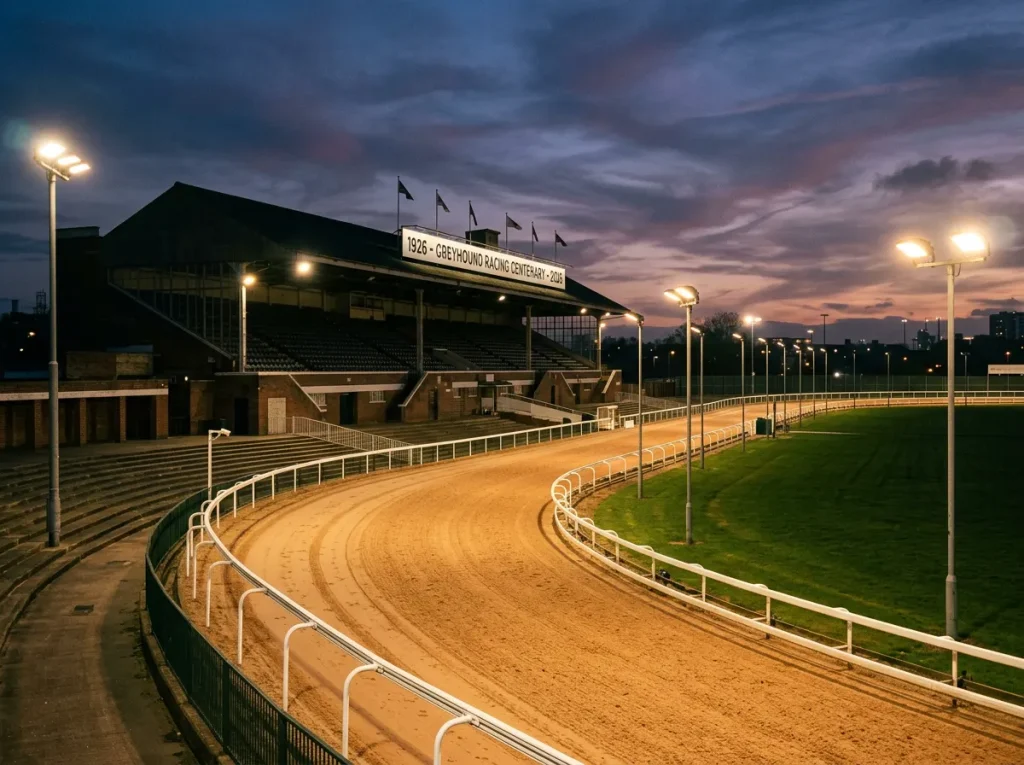
A hundred years is a long time for any sport to survive, and an extraordinary time for one that has spent most of those decades being told it is dying. On 24 July 1926, the first organised greyhound race in Britain took place at Belle Vue Stadium in Manchester, and the sport that emerged from that evening has outlasted two world wars, the rise of television, the collapse of the pools industry and the closure of 91 licensed stadiums. In 2026, UK greyhound racing celebrates its centenary – and as someone who has spent over a decade immersed in the sport’s data and culture, I wanted to look at how we got from that Manchester evening to the 18 licensed tracks that remain today.
See also: yarmouth dogs results and explore greyhound racing history.
1926-1960: The Boom and the Crowds
The speed of greyhound racing’s rise in Britain was staggering by any measure. Within months of the Belle Vue meeting, tracks were opening across the country. The format was perfect for urban working-class entertainment – short meetings, evening schedules that fitted around factory shifts, accessible pricing and the thrill of betting in an era before television brought sport into the living room.
By 1946, the sport had reached a peak that it would never approach again: approximately 70 million spectators passed through greyhound stadium turnstiles in a single year. To put that in perspective, the total UK population at the time was around 49 million. Greyhound racing was not a niche interest – it was one of the most attended spectator events in the country, second only to football and arguably more deeply embedded in the weekly rhythm of working-class life.
Sir Philip Davies, the current GBGB Chairman, marked the centenary in March 2026 by noting that the sport is celebrating 100 years since racing first took place at Belle Vue. That simple statement contains a century of turbulence, reinvention and survival that the Chairman’s speech could only gesture toward. The sport that exists in 2026 bears almost no structural resemblance to the one that drew those 70 million spectators, but the core activity – six dogs chasing a mechanical hare around an oval track – has not changed at all.
1960-2010: Stadium Closures and Shrinking Footprint
The decline was not sudden. It was a slow contraction that took five decades and swallowed 91 licensed stadiums between 1960 and 2010. The causes were multiple and reinforcing: television brought other entertainment into the home, the Betting and Gaming Act 1960 legalised off-course cash betting which removed the need to attend a track to place a wager, and urban land values made stadium sites more valuable as development plots than as racing venues.
Each closure removed not just a stadium but an entire local ecosystem – trainers, kennel staff, track maintenance crews, catering operations and the regulars who treated their weekly visit as a social institution. The sport retreated from cities where it had once packed stands, and the surviving tracks became increasingly dependent on the commercial betting market rather than gate receipts for their revenue.
By the mid-2000s, the closures had slowed but not stopped. The remaining tracks were, broadly, the ones with the strongest commercial relationships with the betting industry – the venues that could sustain a BAGS contract, generate media content and attract enough dogs and trainers to fill a competitive card. The stadium closures of the previous decades had been driven by economics; the survival of the remaining tracks was driven by the same force. Greyhound racing in Britain did not endure because of tradition or sentimentality. It endured because it found a commercial model that worked – barely, imperfectly, but enough to keep the doors open.
The last independent “flapping” track in England – an unlicensed venue operating outside the GBGB regulatory framework – closed in March 2025. That closure marked the end of a tradition that had run parallel to the licensed sport for its entire history, and it left the 18 GBGB stadiums as the sole remaining venues for greyhound racing in Britain. The consolidation is complete. There is no grassroots layer underneath the licensed circuit anymore.
2026: What the Centenary Calendar Includes
The GBGB has planned an ambitious centenary programme: 50 Category One competitions and 27 Category Two events spread across the 2026 calendar. These headline figures represent a significant uplift in the volume of premium racing, designed to celebrate the anniversary year with the highest-quality competition the sport can produce.
A particular milestone landed on 7 March 2026 when Dunstall Park hosted the first-ever combined horse and greyhound racing meeting in British history. The event was conceived as a centenary showcase – a demonstration that the sport can innovate and attract new audiences even in its hundredth year. Whether combined meetings become a regular feature or remain a one-off remains to be seen, but the symbolism of the event was clear: greyhound racing is not content to celebrate its past in a museum.
The centenary also arrives at a moment of existential tension for the sport. Wales and Scotland have voted to ban greyhound racing, and the English debate is intensifying. The industry’s celebration of its history sits alongside genuine uncertainty about its future, which gives the centenary year a bittersweet quality that anyone connected to the sport can feel. At venues like Yarmouth – a track with its own history stretching back to 1928, just two years after Belle Vue – the centenary is both a celebration and a reminder of how much the sport has contracted over a hundred years.
The current circuit of 18 licensed stadiums, staffed by around 500 trainers and 3,000 kennel staff, produces a product that would be unrecognisable to the spectators who packed Belle Vue in 1926. The hare is mechanical, the timing is electronic, the surface is scientifically maintained, the welfare regime is regulated and inspected, and the entire commercial model is built around a media rights structure that did not exist until the late twentieth century. What has not changed is the fundamental proposition: six dogs, one lure, a short burst of furious racing and a result that settles in seconds. That proposition has survived a hundred years, and its survival is the story the centenary tells.
I have covered the specific impact of the legislative changes on Yarmouth and the English racing circuit in the broader Yarmouth results and analysis guide, but the centenary context shapes everything the sport does in 2026 and beyond.
See also: Greyhound Racing Funding UK for more details on this topic.
